
What if some light slips out of visibility but remains gravitationally present?
Arcseconds of possibility
Rethinking gravity, light, and the hidden structure of the universe.
ArcSecs is a custom editorial home for bold physics essays: slow-light dark matter, tired light, photon mass, variable light speed, redshift alternatives, and cosmological anomalies treated as invitations to think harder.
Start Here
New pages, one research path.
Use the ArcSecs Research Hub to move from the premise, to the framework comparison, to the cosmic anomalies tracker, and then into the Physics Engine Demo.
Measure the universe without lightyears
Distance starts with geometry. Time starts with relation.
ArcSecs is testing a speculative framework where cosmic distance starts with parallax, parsecs, arcseconds, angular geometry, and gravitational-wave baselines instead of lightyears. Light is treated as an observation channel that can lag, fade, red-shift, stretch, degrade, become uncertain, or disappear below detection threshold.
Boundary: speculative research visualization, built for comparison, testing, validation, and falsification.
Gravity first, light later
New multi-messenger timing page.
Use GW170817, GW150914, and GW190521 to separate gravitational-wave baselines, electromagnetic source delay, environment diffusion, and speculative light-slowing tests.
Explore the Dark Matter Drive Simulator
A live ArcSecs blueprint for field capture, shielding, energy ledgers, thermal stress, and replayable speculative physics experiments.
The simulator page is provided by the ArcSecs plugin. The main site links to it as the propulsion sandbox without duplicating plugin code, TypeScript, or CSS.
Primary path
Start simple. Go deeper only when ready.
The home page now gives visitors one obvious sequence instead of making every advanced page compete for attention at once.
01
Start Here
Begin with the research map, scientific boundary, and recommended reading order.
Open hub → 02 Compare the PhysicsSee the mainstream Lambda-CDM lane beside the speculative ArcSecs lane.
Compare → 03 Track AnomaliesReview pressure points, evidence grades, and failure conditions.
Inspect → 04 Run SimulationsMove from essay claims into toggles, telemetry, and replayable experiments.
Run demo → 05 Distance-Time FrameworkLearn the no-lightyear distance and clockless progression framework before comparing gravity-wave baselines against degraded light.
Open framework → 06 Explore PropulsionOpen the plugin-owned Dark Matter Drive propulsion sandbox.
Open drive → 07 Read Source / DocsBrowse the Research Library, scientific links, constraints, limitations, TypeScript source, llms.txt, sitemap, .uai, and /docs memory for handoff.
Open library →Questioning whether a mathematical shortcut became mistaken for a physical object.
Asking what hidden changes in light behavior could do across cosmic distance.
Signal map
A field guide for the hidden universe.
Articles connect redshift, photon behavior, gravity, slow light, cosmological horizons, and the dark sector into a single speculative research language.
Redshift
Distance, energy loss, and cosmic interpretation.

Photon mass
Testing whether light is only a messenger or also a participant.

Dark sector
Invisible influence, hidden light, and metrology-grade experiments.

Evidence library
Check the sources behind the claims.
Open the Research Library for grouped scientific links, source roles, support statements, limitations, and simulation prompts.
Evidence & Sources
Source trail: what supports the pressure points, and what it does not prove.
This source layer separates observations, mainstream constraints, alternative ideas, ArcSecs simulation prompts, and engineering analogies. The goal is credibility, not link dumping.
Multi-messenger timing
Gravitational-wave detections and electromagnetic counterparts provide a timing laboratory for separating source delay, environment delay, and any speculative propagation effect.
Mainstream observational source
GW170817: A Short Review of the First Multimessenger Event in Gravitational Astronomy
What this source supports
GW170817 is the benchmark event where gravitational waves were detected before the gamma-ray and optical counterpart, making it the cleanest local timing anchor.
What this source does not proveThe observed lag does not by itself prove cosmological light slowing; most of the delay can be source and ejecta physics.
Mainstream model constraint arXiv — The Delay Time of Gravitational Wave / Gamma-Ray Burst Associations What this source supportsDelay-time modeling is a mainstream concern when connecting gravitational-wave events to electromagnetic transients.
What this source does not proveIt does not establish the ArcSecs attenuation model; it shows why delay decomposition matters.
Mainstream observational source Fermi GBM observations of LIGO gravitational-wave event GW150914 What this source supportsGW150914 is useful as a debated electromagnetic-counterpart stress case for any propagation-delay model.
What this source does not proveThe gamma-ray transient association is debated and should not be used as a confirmed calibration point without caveats.
Mainstream model constraint GW190521: a binary black hole merger inside an active galactic nucleus? What this source supportsGW190521 and its possible optical flare counterpart motivate environment and AGN diffusion checks.
What this source does not proveA delayed optical flare candidate does not prove a universal vacuum light-slowing law; local environment can dominate.
ArcSecs simulation prompt ArcSecs Multi-Messenger Light Delay page What this source supportsA site-owned checklist for simulating gravitational-wave baselines, electromagnetic source delays, environment delays, and candidate propagation attenuation.
What this source does not proveA page and simulator prompt are not observational confirmation; they define what the model must test and where it can fail.
Hubble tension
Distance-ladder and early-universe Hubble constant estimates remain a useful pressure test for expansion history, calibration, and redshift interpretation.
Mainstream model constraint
CERN Courier — The Hubble tension
What this source supports
The mainstream community recognizes the Hubble constant disagreement as a serious precision-cosmology tension.
What this source does not proveIt does not prove tired light, a static universe, or the ArcSecs redshift branch.
Mainstream observational source arXiv — Dissecting the Hubble tension with sound-horizon-free H0 measurements What this source supportsA measurement-comparison framework for separating distance-ladder, model-dependent, and model-independent H0 estimates.
What this source does not proveIt does not establish that metric expansion is wrong; it helps define the comparison problem.
ArcSecs simulation prompt ArcSecs redshift comparison and failure-ledger prompt What this source supportsA site-owned test prompt for comparing metric redshift, tired-light decay, dimming, time stretch, and energy accounting.
What this source does not proveA prompt is not evidence; it is a checklist for what the simulator must expose.
JWST early galaxies
Very distant luminous or mature-looking galaxies stress early-galaxy formation timelines and force better spectroscopy, dust, and population modeling.
Mainstream observational source
NASA Webb — Webb finds most distant known galaxy
What this source supports
JWST observations have identified extremely high-redshift galaxies that make early structure formation an active research area.
What this source does not proveIt does not prove the universe is static or that high-redshift galaxies are old in the ArcSecs sense.
Mainstream observational source Steward Observatory — Webb discovers the earliest known galaxy What this source supportsIndependent science communication around early JWST galaxy discoveries and the need for follow-up interpretation.
What this source does not proveIt does not remove the need for mainstream astrophysical explanations such as dust, selection, and stellar-population modeling.
ArcSecs simulation prompt ArcSecs deep-time and optical attenuation prompt What this source supportsA clear place to test whether static-distance redshift, attenuation, and deep-time interpretation branches create measurable predictions.
What this source does not proveIt is not observational confirmation of ArcSecs; it is a modeling challenge.
SPARC / rotation curves
Galaxy rotation curves and radial acceleration relations are valuable because they combine robust observation with deep disagreement about interpretation.
Mainstream observational source
SPARC — Spitzer Photometry and Accurate Rotation Curves database
What this source supports
High-quality galaxy rotation-curve and photometry data used in dark matter and modified-gravity debates.
What this source does not proveThe data alone does not decide between cold dark matter, modified gravity, or an ArcSecs condensate model.
Mainstream model constraint arXiv — SPARC galaxies prefer Dark Matter over MOND What this source supportsAn example of mainstream-model comparison arguing that SPARC data can favor dark matter over MOND-style alternatives.
What this source does not proveIt does not prove any ArcSecs dark-sector interpretation; it sets a bar that alternatives must meet.
ArcSecs simulation prompt ArcSecs condensate-density and rotation-curve prompt What this source supportsA route into testing whether a slow-light or Proca-photon condensate can mimic halo-like gravity in a visible simulation ledger.
What this source does not proveA matching curve is not enough; lensing, structure, and conservation must also be addressed.
El Gordo cluster
Massive high-redshift cluster collisions stress-test formation timelines, rare-event statistics, mass estimates, and merger velocity modeling.
Mainstream model constraint
Physics World — Are giant galaxy clusters defying standard cosmology?
What this source supports
A public-facing scientific summary of why very massive clusters can function as structure-formation stress tests.
What this source does not proveIt does not by itself falsify Lambda-CDM or establish a static deep-time universe.
Alternative/speculative theory Triton Station — The Fat One, a test of structure formation What this source supportsAn alternative-cosmology discussion of El Gordo as a challenge case for structure formation.
What this source does not proveIt is not a consensus source and should be read as a critical interpretation.
ArcSecs simulation prompt ArcSecs cluster collision and deep-time prompt What this source supportsA model-test route for collision velocity, mass, morphology, and available formation time.
What this source does not proveGranting deep time does not replace the need to reproduce observed mass maps and merger geometry.
Lithium-7 problem
Lithium-7 remains useful because it is a specific abundance mismatch inside an otherwise successful light-element framework.
Mainstream model constraint
arXiv — Big Bang nucleosynthesis and early dark energy constraints
What this source supports
A technical context for how light-element abundances constrain cosmological models.
What this source does not proveIt does not prove ArcSecs chemistry or eliminate standard Big Bang nucleosynthesis successes.
Alternative/speculative theory Triton Station — The Deuterium-Lithium tension in Big Bang Nucleosynthesis What this source supportsA critical discussion of why lithium remains a stubborn mismatch rather than a casual rounding error.
What this source does not proveIt does not prove a non-Big-Bang chemical equilibrium model.
ArcSecs simulation prompt ArcSecs abundance-ledger prompt What this source supportsA test-ledger location for separating deuterium, helium, lithium, depletion, and equilibrium branches.
What this source does not proveA speculative equilibrium idea must preserve successful abundance constraints, not merely explain one mismatch.
Proca photon mass bounds
Photon mass is not observed; the scientific value is in strict upper bounds and the failure states they impose on any massive-photon simulation branch.
Mainstream model constraint
Particle Data Group — Review of Particle Physics
What this source supports
The mainstream constraint environment for particle properties, including extremely tight photon-mass limits.
What this source does not proveAn upper bound is not a detection of photon rest mass.
Mainstream model constraint arXiv — Photon and graviton mass limits What this source supportsA technical survey context for mass-limit reasoning and why any non-zero photon mass must remain tiny.
What this source does not proveIt does not show that Proca photons explain redshift, dark matter, or lensing.
ArcSecs simulation prompt ArcSecs Proca branch and guardrail prompt What this source supportsA source-code-backed prompt for making photon-mass sliders expose dispersion, guardrails, and warnings.
What this source does not proveA simulator control is not a measurement of photon mass.
Tired light criticism and constraints
Tired light deserves a visible failure ledger: supernova stretch, Tolman dimming, image sharpness, CMB structure, and energy accounting cannot be hand-waved.
Mainstream model constraint
Tolman surface brightness test — ADS record
What this source supports
The surface-brightness test is a classic observational constraint that static or tired-light models must confront.
What this source does not proveIt does not rule out every conceivable non-expansion redshift model by itself; it defines a hard test.
Alternative/speculative theory MNRAS — Redshift duality with Pantheon+SH0ES in a Planck-anchored framework What this source supportsA modern example of redshift interpretation being explored with observational datasets.
What this source does not proveIt does not prove classic tired light or the ArcSecs Proca/tired-light condensate model.
ArcSecs simulation prompt ArcSecs tired-light failure-ledger prompt What this source supportsA public page location for keeping redshift, dimming, timing, blurring, and energy sinks visible together.
What this source does not proveMatching redshift alone is not enough to validate the branch.
Dark matter / alternative propulsion concepts
The propulsion material is explicitly a speculative engineering analogy layer: field capture, slow light, polaritons, shielding, energy ledgers, and thermal stress.
Engineering analogy
Nature — Light speed reduction to 17 metres per second
What this source supports
A real laboratory slow-light result that helps explain why ArcSecs uses slow-light and EIT language as an analogy.
What this source does not proveLaboratory slow light does not prove dark matter is slow light or that a starship can harvest it.
Engineering analogy NASA NTRS — Breakthrough Propulsion Physics project overview What this source supportsA public research-program context for speculative propulsion being treated as physics-bound inquiry rather than magic.
What this source does not proveIt does not validate the Dark Matter Drive; it supports disciplined speculative propulsion framing.
ArcSecs simulation prompt ArcSecs Dark Matter Drive Simulator route What this source supportsThe plugin-owned place to test field capture, shielding, energy ledgers, thermal bottlenecks, and deterministic replay.
What this source does not proveA simulator page is not an engineering demonstration or proof of propulsion feasibility.
No evidence sources match those filters.
Propulsion sandbox
Run the Dark Matter Drive Simulator
Explore shielding, ramjet capture, tired-light energy accounting, massive photon lensing, thermal bottlenecks, and deterministic replay in the ArcSecs speculative physics sandbox.
Latest signals
New ArcSecs articles
The newest essays are shown here automatically. The full archive lives at /blog/.
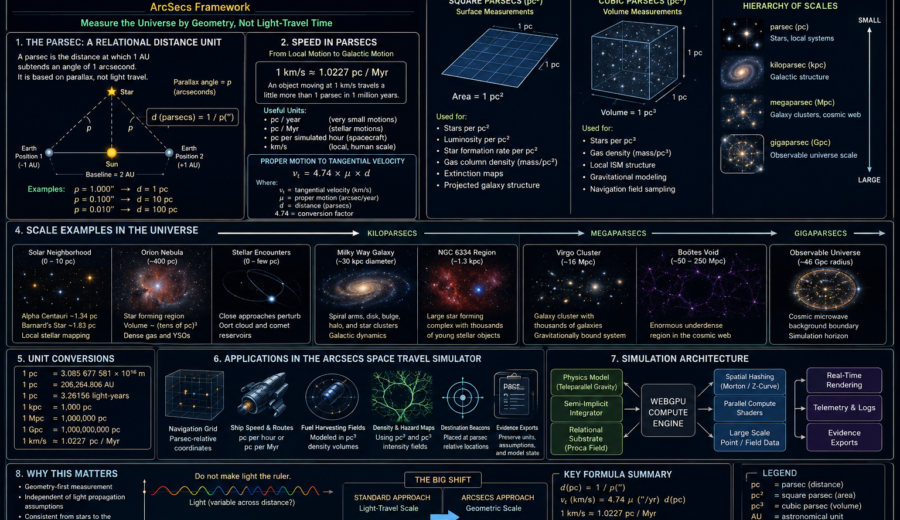
Parsecs for Speed and Area: A Geometric Framework for Measuring Motion, Density, and Cosmic Scale
The parsec is more than an astronomy unit. In the ArcSecs framework, it becomes the foundation for a geometric, relational model of distance, speed, surface density, volume, and cosmic simulation…
Read signal →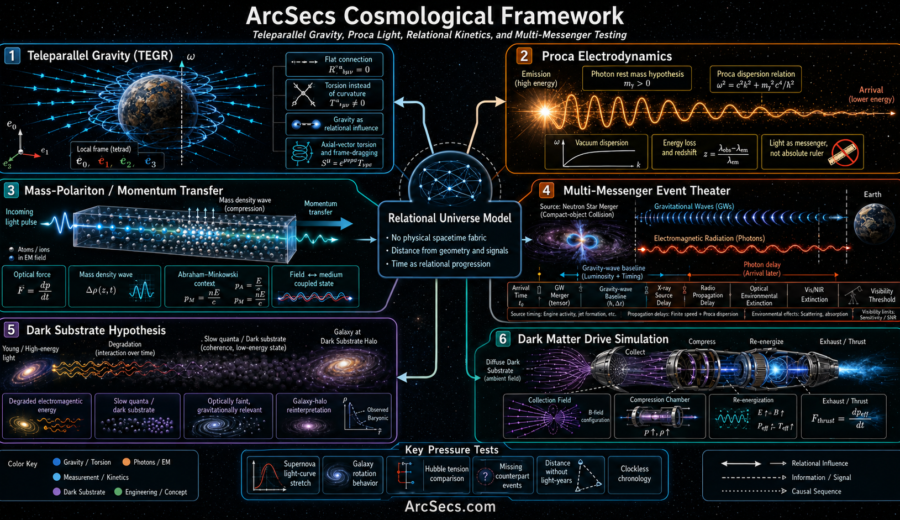
Teleparallel Gravity, Proca Light, and Relational Kinetics Without Spacetime
A detailed ArcSecs article explaining how teleparallel gravity, massive-light hypotheses, mass-polariton momentum, tired-light pressure tests, and dark-state polariton analogies fit into a falsifiable research framework without treating spacetime as a…
Read signal →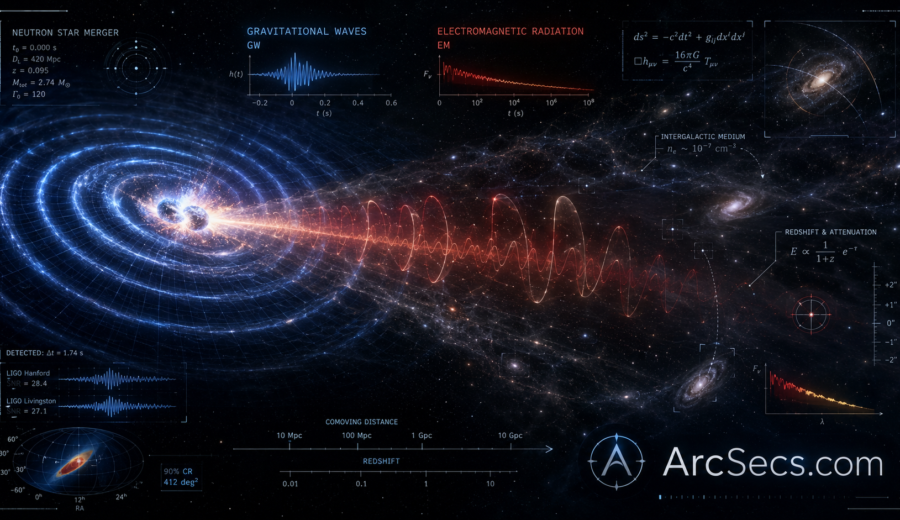
Modeling Light Slowing and Energy Degeneration Against Gravitational Waves
What if gravitational waves act as the universe’s clean timing signal while electromagnetic light slowly loses speed and energy across cosmic distance? This ArcSecs research essay explores a speculative decoupled…
Read signal →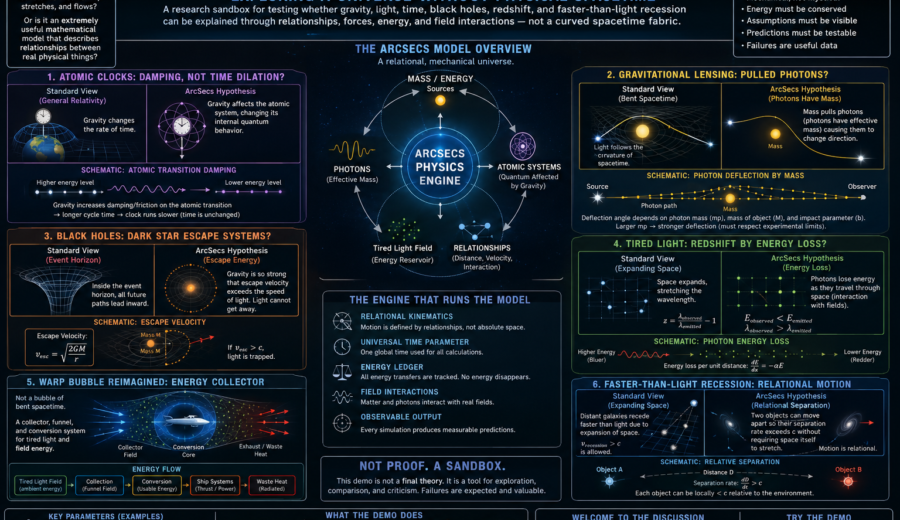
What the ArcSecs Physics Engine Demo Is Trying to Show
The ArcSecs Physics Engine Demo is not a finished theory, a classroom animation, or a claim that one browser simulation has overturned modern physics. It is a public research sandbox…
Read signal →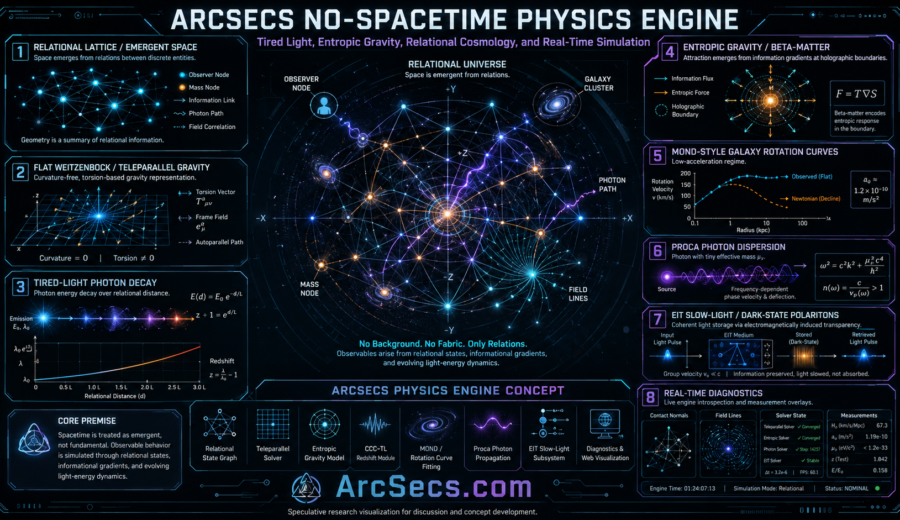
Building a No-Spacetime Physics Engine: Tired Light, Entropic Gravity, and the ArcSecs Relational Universe
The ArcSecs physics engine explores a radical simulation idea: build a working cosmology without treating spacetime as a physical fabric. Instead of expanding coordinates, it models light, gravity, rotation curves,…
Read signal →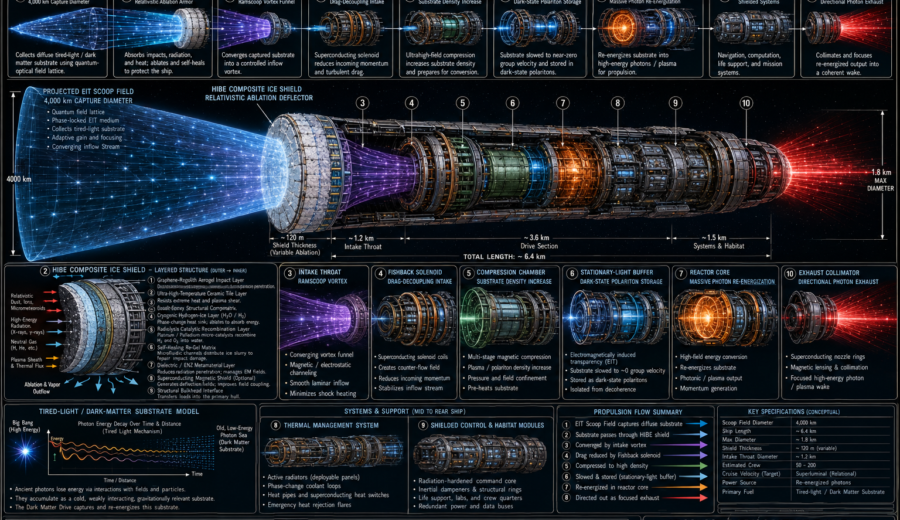
Dark Matter Drive Schematic: Tired Light, No Spacetime, and the ArcSecs Physics Engine
A detailed speculative physics article explaining the Dark Matter Drive schematic, HIBE ice shield, EIT scoop, tired-light substrate, no-spacetime cosmology, and ArcSecs relational physics engine.
Read signal →