
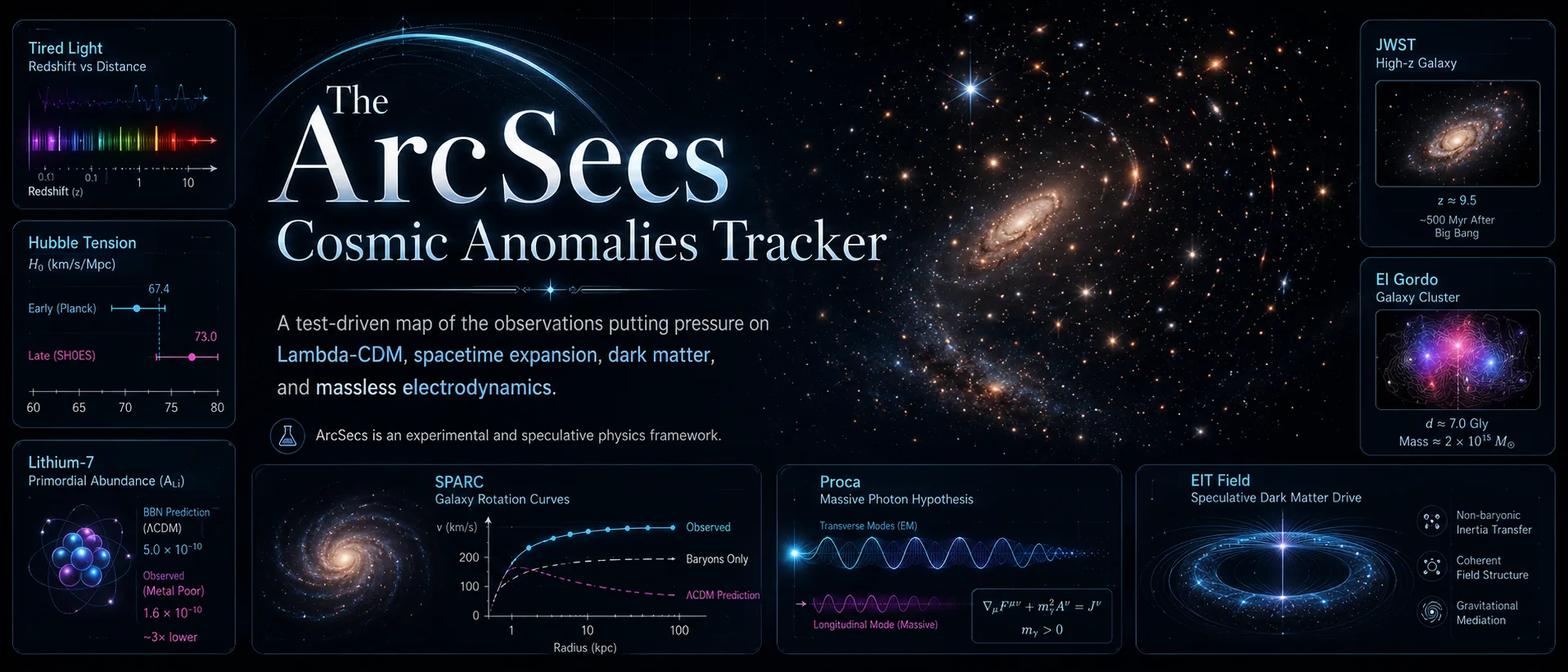
The ArcSecs Cosmic Anomalies Tracker
A test-driven map of the observations putting pressure on Lambda-CDM, spacetime expansion, dark matter, and massless electrodynamics.
This is a tracker, not just an article. It organizes real astronomical pressure points and compares the mainstream Lambda-CDM interpretation, the observational problem, the speculative ArcSecs interpretation, and the simulation hook that should make the idea testable instead of rhetorical.
Science framing: ArcSecs is an experimental and speculative physics framework. This tracker compares mainstream cosmological explanations with alternative ArcSecs interpretations for research, simulation, and critical-thinking purposes.
Turn the anomaly list into a workflow.
The tracker is easier to use when visitors separate what was observed, how mainstream cosmology explains it, what ArcSecs is testing, and what would make a claim fail.
Start with the observation
Read the empirical pressure point first: redshift, early galaxies, rotation curves, clusters, element abundance, or electrodynamic limits.
Open dashboard →Check the mainstream lane
Use the mainstream explanation as the control case before giving any speculative branch credit.
Filter the tracker →Read the ArcSecs lane
Only then compare tired light, Proca photons, condensate dark matter, relational inertia, or propulsion implications.
Open the pressure ledger →End with a kill test
Every strong claim needs a failure condition. The run builder turns each anomaly into a test recipe.
Build a run card →Dashboard of pressure points.
Each card names the mainstream dependency, the ArcSecs lens, and the place where a simulation should make the claim visible enough to argue with.
Hubble Tension
Mainstream dependency: Expansion history, distance ladder calibration, early-universe CMB inference, dark energy assumptions.
ArcSecs lens: Tired light, variable light speed, redshift duality, and cumulative photon-energy decay as explicit simulation branches.
Evidence grade: Active Interpretation
Open section → Active DebateJWST Mature Early Galaxies
Mainstream dependency: Big Bang timeline, hierarchical structure formation, early star-formation efficiency, stellar population modeling.
ArcSecs lens: Static-distance redshift interpretation, optical attenuation, deep-time galaxies, and mass-boom scenario tests.
Evidence grade: Active Interpretation
Open section → Simulation TargetSPARC / Galaxy Rotation Curves
Mainstream dependency: Cold dark matter halos, baryonic feedback, modified gravity comparisons, and acceleration-scale regularities.
ArcSecs lens: Massive Proca photon condensate behaving like an optically inactive gravitational halo.
Evidence grade: Established Observation
Open section → Extreme EventEl Gordo Cluster Collision
Mainstream dependency: Hierarchical structure formation, cluster mass estimates, merger velocities, and dark matter halo growth.
ArcSecs lens: Deep-time structure formation without a strict young-universe bottleneck.
Evidence grade: Active Interpretation
Open section → Abundance StressLithium-7 Problem
Mainstream dependency: Big Bang nucleosynthesis, stellar depletion, nuclear reaction rates, and possible new particle physics.
ArcSecs lens: Long-term chemical equilibrium instead of a single primordial abundance freeze-out.
Evidence grade: Established Observation
Open section → Guardrail TestPhoton Mass / Proca Electrodynamics
Mainstream dependency: Massless photons, gauge invariance, Maxwell electrodynamics, and extremely tight experimental upper bounds.
ArcSecs lens: Tiny non-zero photon mass enabling Proca dispersion, longitudinal modes, and tired-light condensate behavior.
Evidence grade: Boundary Constraint
Open section → Historic ChallengeTired Light / Redshift Duality
Mainstream dependency: Metric expansion, supernova time dilation, Tolman surface brightness, image sharpness, and energy conservation.
ArcSecs lens: Photon energy loss over cosmological distance plus explicit checks for time-stretch, dimming, and blurring failures.
Evidence grade: Speculative Extension
Open section → Propulsion Thought ExperimentDark Matter Drive Implications
Mainstream dependency: Dark matter ontology, relativistic protection, propulsion energetics, EIT analogies, and thermal accounting.
ArcSecs lens: Harvest, compress, and redirect a massive slow-light substrate instead of moving spacetime geometry.
Evidence grade: Speculative Extension
Open section →Separate the observation from the interpretation.
This page is stronger when it refuses to blur data, mainstream inference, ArcSecs hypothesis, and engineering speculation. The evidence-grade filter below keeps those lanes visible.
Established Observation
Measurements or repeatable empirical patterns worth taking seriously even when interpretations differ.
Active Interpretation
Areas where the observation is real, but the model-level meaning is still being argued, calibrated, or refined.
Boundary Constraint
Guardrail physics, such as photon-mass limits, that should constrain the simulation before a scenario is treated as plausible.
Speculative Extension
ArcSecs-only branches that belong in the demo as explicit thought experiments with pass conditions and failure states.
Read the sky first, then the theory.
The new review mode lets visitors dim ArcSecs-only interpretation lanes without deleting them. That makes the page useful for skeptics, supporters, and visitors who want to inspect the observation before reading the speculative branch.
Observation
Start with what was measured: redshift disagreements, mature-looking distant galaxies, rotation curves, cluster masses, abundance mismatches, or electrodynamic bounds.
Mainstream interpretation
Review the conventional Lambda-CDM or Standard Model explanation before deciding whether the observation is actually a pressure point.
ArcSecs branch
Then restore the speculative lane and inspect whether tired light, Proca photons, relational inertia, or condensate behavior gives a real testable contrast.
Kill test
End with the failure condition. A claim that cannot name its own failure state is not ready for the demo.
Filter the anomaly map.
The controls are progressive enhancement. Without JavaScript, every tracker card remains readable and linkable.
Hubble Tension
Observation: Early-universe CMB-derived Hubble constant estimates differ from local distance-ladder measurements.
Mainstream View
Mainstream cosmology generally treats the tension as a calibration, systematic, or new-physics problem inside an expanding-universe framework. Candidate explanations include early dark energy, modified expansion history, refined Cepheid calibration, and other extensions.
Pressure Point
The numbers are precise enough that the disagreement is no longer easy to dismiss as casual measurement noise, but the field still debates whether it is a hidden systematic or a real crack in the model.
ArcSecs View
The speculative ArcSecs interpretation asks whether observed redshift must be treated as pure metric expansion. It models tired-light attenuation, Proca dispersion, and pulse stretching as testable alternatives, not as settled replacements.
Evidence / Interpretation / Simulation hook
Evidence grade: Active Interpretation
Evidence status: Strong observational pressure point; mainstream active debate; ArcSecs simulation target.
Simulation hook: Redshift decay, tired-light attenuation, variable-speed-of-light toggles, and supernova pulse-stretching telemetry in the Physics Engine Demo.
JWST Mature Early Galaxies
Observation: JWST has reported very distant, surprisingly luminous, structurally developed, or chemically enriched galaxies that appear early in the standard timeline.
Mainstream View
Mainstream responses include earlier-than-expected star formation, revised galaxy formation models, selection effects, dust and stellar-population uncertainties, and improved spectroscopic follow-up.
Pressure Point
The pressure point is not one galaxy alone; it is the pattern of mature-looking high-redshift systems that pushes formation models to become faster, more efficient, and more nuanced.
ArcSecs View
ArcSecs explores the possibility that some high-redshift maturity problems are artifacts of forcing static-distance observations into an expanding-metric age ladder.
Evidence / Interpretation / Simulation hook
Evidence grade: Active Interpretation
Evidence status: Fast-moving observational field; mainstream modeling is adapting; ArcSecs treats the anomalies as deep-time simulation tests.
Simulation hook: Static-distance redshift mode, mass-boom branch, optical attenuation controls, and galaxy-age interpretation panels.
SPARC / Galaxy Rotation Curves
Observation: Galaxy rotation curves and radial acceleration relations show tight empirical behavior across diverse galaxy types.
Mainstream View
Mainstream Lambda-CDM uses cold dark matter halos plus baryonic feedback, while modified-gravity alternatives try to capture the empirical acceleration relation more directly.
Pressure Point
The regularity of the relation is a pressure point because dark matter halos should be complex, history-dependent structures, yet the data often follows simple patterns.
ArcSecs View
ArcSecs proposes a speculative tired-light condensate: ancient degraded photons become optically inactive but still mass-bearing, pooling around galaxies as a dark-sector field.
Evidence / Interpretation / Simulation hook
Evidence grade: Established Observation
Evidence status: Well-observed galaxy-scale issue; mainstream and alternative interpretations remain debated; condensate model is speculative.
Simulation hook: Rotation-curve visualizer, Proca photon mass slider, condensate density field, and baryonic-vs-condensate acceleration comparison.
El Gordo Cluster Collision
Observation: The El Gordo galaxy cluster is a massive, high-redshift merging system often discussed as difficult to reproduce in simple structure-formation timelines.
Mainstream View
Mainstream explanations treat it as a rare extreme event and refine mass estimates, selection effects, and hydrodynamical simulations.
Pressure Point
The pressure comes from combining mass, redshift, merger speed, and morphology. A single rare object can be survivable; a pattern of extreme structures would be harder.
ArcSecs View
ArcSecs asks whether a static or deep-time universe makes such massive structures less surprising by giving clusters far longer to form, drift, and collide.
Evidence / Interpretation / Simulation hook
Evidence grade: Active Interpretation
Evidence status: Interesting high-mass cluster case; not a standalone falsification; useful as a simulation stress test.
Simulation hook: Cluster collision velocity sandbox, deep-time structure formation mode, and merger-energy accounting ledger.
Lithium-7 Problem
Observation: Standard Big Bang nucleosynthesis predicts more Lithium-7 than is observed in metal-poor halo stars.
Mainstream View
Mainstream explanations include stellar depletion, nuclear reaction uncertainties, and speculative particle-physics modifications during or after nucleosynthesis.
Pressure Point
Deuterium and helium can fit well while Lithium-7 does not, making the mismatch stubborn rather than a broad failure of all light-element modeling.
ArcSecs View
ArcSecs explores whether light-element ratios could be long-term equilibrium signatures in a static or cyclic process rather than one-time primordial leftovers.
Evidence / Interpretation / Simulation hook
Evidence grade: Established Observation
Evidence status: Known mainstream problem; not proof against Big Bang cosmology; useful as an accounting benchmark.
Simulation hook: Element abundance equilibrium panel, chemistry ledger, or future nucleosynthesis stress-test module.
Photon Mass / Proca Electrodynamics
Observation: Mainstream physics treats photons as massless, while experiments place strict upper bounds rather than measuring a non-zero mass.
Mainstream View
A zero photon rest mass preserves the standard electromagnetic framework and agrees with extraordinarily successful experiments.
Pressure Point
The pressure is not that photon mass has been observed; it is that a simulation can expose exactly how tiny a non-zero mass would have to be and what contradictions it creates.
ArcSecs View
ArcSecs uses Proca electrodynamics as a speculative branch where photon mass creates frequency-dependent vacuum dispersion and dark-sector accumulation over distance.
Evidence / Interpretation / Simulation hook
Evidence grade: Boundary Constraint
Evidence status: Highly speculative. Must stay inside experimental upper bounds and show failure states openly.
Simulation hook: Photon mass upper-bound slider, dispersion visualization, longitudinal polarization concept panel, and conservation warnings.
Tired Light / Redshift Duality
Observation: Cosmological redshift is normally interpreted as expansion of space, while tired-light ideas try to explain redshift through energy loss over distance.
Mainstream View
Mainstream cosmology rejects classic tired-light models because they historically struggle with supernova time dilation, Tolman dimming, image sharpness, and the CMB.
Pressure Point
The useful pressure point is comparative: any alternative must reproduce more than a redshift-distance curve.
ArcSecs View
ArcSecs turns tired light into a visible test case. It should show where the model passes, where it fails, and which extra assumptions are being smuggled in.
Evidence / Interpretation / Simulation hook
Evidence grade: Speculative Extension
Evidence status: Historically difficult alternative; appropriate only as a transparent computational thought experiment.
Simulation hook: Metric redshift versus tired-light redshift toggle, Tolman-style brightness check, image-blur warning, and supernova stretch comparison.
Dark Matter Drive Implications
Observation: If dark matter were a massive photon condensate, propulsion concepts could be reframed around interacting with that medium.
Mainstream View
Mainstream propulsion concepts at this scale remain speculative; dark matter is not an available engineering fuel in accepted physics.
Pressure Point
The pressure is engineering honesty: drag, heat, shielding, capture efficiency, exhaust momentum, and conservation cannot be hand-waved.
ArcSecs View
ArcSecs explores a dark matter ramjet using EIT-style scoop fields, dark-state polariton analogies, stationary-light capture, HIBE shielding, and reactor re-ingestion.
Evidence / Interpretation / Simulation hook
Evidence grade: Speculative Extension
Evidence status: Speculative extension only. Treat as a simulation concept, not demonstrated engineering.
Simulation hook: Dark Matter Drive simulation scenario inside the Physics Engine Demo, with scoop, shield, reactor, thermal, and exhaust ledgers.
No tracker cards match those filters.
Pressure ledger: what each anomaly costs.
This ledger is the anti-hype layer. Higher scores do not mean ArcSecs is proven; they show where the observation is mature, where mainstream explanations are carrying load, where ArcSecs has enough structure to simulate, and which items deserve demo priority.
Hubble Tension
Mainstream cost: Distance-ladder systematics, early-dark-energy branches, or modified expansion history must be constrained without breaking CMB and BAO successes.
ArcSecs cost: A tired-light or redshift-duality branch must reproduce supernova stretch, surface-brightness dimming, image sharpness, and CMB constraints.
Failure condition: If redshift-decay settings cannot reproduce time dilation and Tolman-style dimming together, the branch should visibly fail.
JWST Mature Early Galaxies
Mainstream cost: Earlier star formation, dust corrections, top-heavy stellar populations, feedback changes, and spectroscopic follow-up must converge.
ArcSecs cost: A static-distance interpretation must explain why the same sky also appears to contain a coherent CMB, nucleosynthesis signatures, and large-scale structure.
Failure condition: If improved spectroscopy and population modeling remove the maturity stress, this item should downgrade from pressure point to calibration lesson.
SPARC / Galaxy Rotation Curves
Mainstream cost: Cold dark matter halos and baryonic feedback must explain tight acceleration regularities without excessive tuning.
ArcSecs cost: A Proca condensate must produce halo-like gravity while staying optically inactive and respecting photon-mass bounds.
Failure condition: If condensate density cannot recover a credible rotation curve without violating photon-mass guardrails, mark the branch invalid.
El Gordo Cluster Collision
Mainstream cost: Extreme-event probabilities, mass estimates, merger velocities, and simulation selection effects must remain statistically plausible.
ArcSecs cost: Deep-time structure formation must still account for observed cluster distributions, lensing, gas morphology, and merger rates.
Failure condition: If mainstream simulations reproduce the cluster population without strained tails, the ArcSecs pressure score should drop.
Lithium-7 Problem
Mainstream cost: Stellar depletion, nuclear rates, and possible particle extensions must fix lithium without breaking deuterium and helium agreement.
ArcSecs cost: A non-Big-Bang abundance model must replace an entire successful nucleosynthesis framework, not only one isotope mismatch.
Failure condition: If the tracker cannot model deuterium, helium, and lithium together, it should not use lithium as a standalone victory claim.
Photon Mass / Proca Electrodynamics
Mainstream cost: Massless photons remain the clean, successful baseline; any non-zero mass branch must be treated as bounded speculation.
ArcSecs cost: Proca behavior must stay below empirical limits while still generating meaningful dispersion over cosmic distances.
Failure condition: If the required photon mass exceeds published upper bounds, the UI should flag the scenario as ruled out for that parameter set.
Tired Light / Redshift Duality
Mainstream cost: The expanding-universe interpretation must continue integrating CMB, BAO, supernovae, and structure formation consistently.
ArcSecs cost: Tired light must overcome its historic failures: image blur, time dilation, surface brightness, and energy accounting.
Failure condition: If energy loss creates blur or dimming mismatches outside observational tolerance, the branch should fail loudly.
Dark Matter Drive Implications
Mainstream cost: Accepted physics does not provide an engineerable dark-matter fuel stream or demonstrated macroscopic EIT scoop.
ArcSecs cost: The drive concept must close drag, heat, shielding, intake, exhaust, and conservation ledgers before it is more than a story engine.
Failure condition: If capture energy exceeds usable output or heat cannot be rejected, the simulator should mark the propulsion profile as non-viable.
Build a simulation run card.
Pick an anomaly and the page turns it into a compact demo recipe: objective, controls to touch, pass condition, and failure condition. This makes the tracker a launchpad for test-driven simulation instead of a static article.
Why build a Cosmic Anomalies Tracker?
Because a model should be strongest where the observations are hardest.
The problem with treating models as untouchable
Lambda-CDM is the mainstream baseline because it explains a large amount of evidence with a compact framework. That deserves respect. But a baseline is not a shrine. When observations create tension, a healthy scientific culture should make those tensions visible, not bury them under jargon or team loyalty.
ArcSecs uses a software-engineering metaphor: treat cosmology like a codebase. A theory has dependencies, assumptions, regression tests, edge cases, and failure modes. The point of the tracker is to keep those stress tests organized.
Evidence, interpretation, simulation
Every tracker item separates the observation from the interpretation. That matters because the same observation can be explained through different assumptions. The ArcSecs side is speculative, so the most honest way to present it is as a simulation target with explicit checks.
A good alternative model should not merely sound clever. It should expose what it predicts, what it costs, and what would falsify or weaken it.
Hubble tension: expansion rate or redshift interpretation problem?
Mainstream interpretation
The mainstream view keeps metric expansion and asks whether the local distance ladder, early-universe inference, dark energy behavior, or high-redshift physics needs adjustment.
ArcSecs speculative interpretation
ArcSecs asks whether part of redshift could be cumulative photon-energy decay, dispersion, or variable light-speed behavior on a static relational stage. That is a demanding claim because it must also address supernova time dilation, brightness dimming, image sharpness, the CMB, and baryon acoustic features.
JWST and the problem of mature early galaxies.
JWST did not make Lambda-CDM vanish. It did make early structure formation more interesting, more constrained, and harder to oversimplify.
The mainstream answer is to improve the astrophysics: star formation may turn on earlier, galaxies may be brighter than expected, feedback may behave differently, and some candidates may shift after better spectroscopy. The ArcSecs answer is more radical: maybe high-redshift systems are not young in the way the expansion timeline says they are. The tracker keeps both ideas side by side and points to the simulation settings that would have to do the work.
Rotation curves, SPARC, and the dark matter question.
Cold dark matter halos
The mainstream solution gives galaxies invisible mass halos and uses baryonic feedback to explain detailed structure.
Modified gravity
Alternatives such as MOND-style approaches focus on the tight empirical acceleration relation.
ArcSecs condensate
ArcSecs explores whether exhausted Proca photons could become an optically dark, gravitationally relevant condensate.
El Gordo and deep-time structure formation.
The El Gordo cluster is useful because it turns structure formation into a stress test: mass, merger velocity, redshift, and morphology have to be explained together. Mainstream cosmology can treat it as a rare event and refine simulations. ArcSecs uses it as a deep-time sandbox: what happens to cluster statistics if the universe is not forced through a short expansion-age bottleneck?
Lithium-7 and Big Bang nucleosynthesis stress.
The Lithium-7 problem is not a theatrical knockout punch against the Big Bang. It is a stubborn mismatch inside an otherwise successful light-element framework. That makes it valuable: it is exactly the kind of anomaly a test-driven page should track with care, not exaggerate.
Proca electrodynamics and the massive photon hypothesis.
Mainstream guardrail
Photon rest mass is treated as zero in standard electromagnetic theory. Any non-zero value must fit inside extremely tight experimental upper bounds and avoid breaking successful physics.
Simulation branch
ArcSecs can still model a tiny Proca-style photon mass as a branch. The branch should show dispersion, energy accounting, longitudinal-mode implications, and warnings when assumptions exceed the guardrails.
Why this matters for the ArcSecs Physics Engine.
The tracker should feed the demo. The demo should feed the tracker.
For timing and redshift branches, open the Multi-Messenger Light Delay page to inspect GW170817, GW150914, and GW190521 as gravitational-wave baseline / electromagnetic-lag stress tests. For the propulsion branch, open the Dark Matter Drive Simulator to inspect field capture, energy accounting, massive photon lensing, shielding, thermal limits, and replay controls without duplicating plugin code in the theme.
Assumption toggles
Photon mass, tired-light decay, variable light-speed mode, condensate density, and dark matter halo assumptions should be switched on deliberately.
Conservation ledgers
Energy, momentum, brightness, timing, heat, drag, and units need visible accounting.
Failure states
When a model cannot match supernova stretch, Tolman dimming, CMB structure, or lensing, the UI should say so clearly.
Conclusion: test the model, do not worship the model. That rule applies to mainstream cosmology, alternative cosmology, and ArcSecs itself.
Run the Physics Engine Demo Compare with the ArcSecs FrameworkSource trail: what supports the pressure points, and what it does not prove.
This source layer separates observations, mainstream constraints, alternative ideas, ArcSecs simulation prompts, and engineering analogies. The goal is credibility, not link dumping.
Multi-messenger timing
Gravitational-wave detections and electromagnetic counterparts provide a timing laboratory for separating source delay, environment delay, and any speculative propagation effect.
GW170817 is the benchmark event where gravitational waves were detected before the gamma-ray and optical counterpart, making it the cleanest local timing anchor.
What this source does not proveThe observed lag does not by itself prove cosmological light slowing; most of the delay can be source and ejecta physics.
Mainstream model constraint arXiv — The Delay Time of Gravitational Wave / Gamma-Ray Burst Associations What this source supportsDelay-time modeling is a mainstream concern when connecting gravitational-wave events to electromagnetic transients.
What this source does not proveIt does not establish the ArcSecs attenuation model; it shows why delay decomposition matters.
Mainstream observational source Fermi GBM observations of LIGO gravitational-wave event GW150914 What this source supportsGW150914 is useful as a debated electromagnetic-counterpart stress case for any propagation-delay model.
What this source does not proveThe gamma-ray transient association is debated and should not be used as a confirmed calibration point without caveats.
Mainstream model constraint GW190521: a binary black hole merger inside an active galactic nucleus? What this source supportsGW190521 and its possible optical flare counterpart motivate environment and AGN diffusion checks.
What this source does not proveA delayed optical flare candidate does not prove a universal vacuum light-slowing law; local environment can dominate.
ArcSecs simulation prompt ArcSecs Multi-Messenger Light Delay page What this source supportsA site-owned checklist for simulating gravitational-wave baselines, electromagnetic source delays, environment delays, and candidate propagation attenuation.
What this source does not proveA page and simulator prompt are not observational confirmation; they define what the model must test and where it can fail.
Hubble tension
Distance-ladder and early-universe Hubble constant estimates remain a useful pressure test for expansion history, calibration, and redshift interpretation.
The mainstream community recognizes the Hubble constant disagreement as a serious precision-cosmology tension.
What this source does not proveIt does not prove tired light, a static universe, or the ArcSecs redshift branch.
Mainstream observational source arXiv — Dissecting the Hubble tension with sound-horizon-free H0 measurements What this source supportsA measurement-comparison framework for separating distance-ladder, model-dependent, and model-independent H0 estimates.
What this source does not proveIt does not establish that metric expansion is wrong; it helps define the comparison problem.
ArcSecs simulation prompt ArcSecs redshift comparison and failure-ledger prompt What this source supportsA site-owned test prompt for comparing metric redshift, tired-light decay, dimming, time stretch, and energy accounting.
What this source does not proveA prompt is not evidence; it is a checklist for what the simulator must expose.
JWST early galaxies
Very distant luminous or mature-looking galaxies stress early-galaxy formation timelines and force better spectroscopy, dust, and population modeling.
JWST observations have identified extremely high-redshift galaxies that make early structure formation an active research area.
What this source does not proveIt does not prove the universe is static or that high-redshift galaxies are old in the ArcSecs sense.
Mainstream observational source Steward Observatory — Webb discovers the earliest known galaxy What this source supportsIndependent science communication around early JWST galaxy discoveries and the need for follow-up interpretation.
What this source does not proveIt does not remove the need for mainstream astrophysical explanations such as dust, selection, and stellar-population modeling.
ArcSecs simulation prompt ArcSecs deep-time and optical attenuation prompt What this source supportsA clear place to test whether static-distance redshift, attenuation, and deep-time interpretation branches create measurable predictions.
What this source does not proveIt is not observational confirmation of ArcSecs; it is a modeling challenge.
SPARC / rotation curves
Galaxy rotation curves and radial acceleration relations are valuable because they combine robust observation with deep disagreement about interpretation.
High-quality galaxy rotation-curve and photometry data used in dark matter and modified-gravity debates.
What this source does not proveThe data alone does not decide between cold dark matter, modified gravity, or an ArcSecs condensate model.
Mainstream model constraint arXiv — SPARC galaxies prefer Dark Matter over MOND What this source supportsAn example of mainstream-model comparison arguing that SPARC data can favor dark matter over MOND-style alternatives.
What this source does not proveIt does not prove any ArcSecs dark-sector interpretation; it sets a bar that alternatives must meet.
ArcSecs simulation prompt ArcSecs condensate-density and rotation-curve prompt What this source supportsA route into testing whether a slow-light or Proca-photon condensate can mimic halo-like gravity in a visible simulation ledger.
What this source does not proveA matching curve is not enough; lensing, structure, and conservation must also be addressed.
El Gordo cluster
Massive high-redshift cluster collisions stress-test formation timelines, rare-event statistics, mass estimates, and merger velocity modeling.
A public-facing scientific summary of why very massive clusters can function as structure-formation stress tests.
What this source does not proveIt does not by itself falsify Lambda-CDM or establish a static deep-time universe.
Alternative/speculative theory Triton Station — The Fat One, a test of structure formation What this source supportsAn alternative-cosmology discussion of El Gordo as a challenge case for structure formation.
What this source does not proveIt is not a consensus source and should be read as a critical interpretation.
ArcSecs simulation prompt ArcSecs cluster collision and deep-time prompt What this source supportsA model-test route for collision velocity, mass, morphology, and available formation time.
What this source does not proveGranting deep time does not replace the need to reproduce observed mass maps and merger geometry.
Lithium-7 problem
Lithium-7 remains useful because it is a specific abundance mismatch inside an otherwise successful light-element framework.
A technical context for how light-element abundances constrain cosmological models.
What this source does not proveIt does not prove ArcSecs chemistry or eliminate standard Big Bang nucleosynthesis successes.
Alternative/speculative theory Triton Station — The Deuterium-Lithium tension in Big Bang Nucleosynthesis What this source supportsA critical discussion of why lithium remains a stubborn mismatch rather than a casual rounding error.
What this source does not proveIt does not prove a non-Big-Bang chemical equilibrium model.
ArcSecs simulation prompt ArcSecs abundance-ledger prompt What this source supportsA test-ledger location for separating deuterium, helium, lithium, depletion, and equilibrium branches.
What this source does not proveA speculative equilibrium idea must preserve successful abundance constraints, not merely explain one mismatch.
Proca photon mass bounds
Photon mass is not observed; the scientific value is in strict upper bounds and the failure states they impose on any massive-photon simulation branch.
The mainstream constraint environment for particle properties, including extremely tight photon-mass limits.
What this source does not proveAn upper bound is not a detection of photon rest mass.
Mainstream model constraint arXiv — Photon and graviton mass limits What this source supportsA technical survey context for mass-limit reasoning and why any non-zero photon mass must remain tiny.
What this source does not proveIt does not show that Proca photons explain redshift, dark matter, or lensing.
ArcSecs simulation prompt ArcSecs Proca branch and guardrail prompt What this source supportsA source-code-backed prompt for making photon-mass sliders expose dispersion, guardrails, and warnings.
What this source does not proveA simulator control is not a measurement of photon mass.
Tired light criticism and constraints
Tired light deserves a visible failure ledger: supernova stretch, Tolman dimming, image sharpness, CMB structure, and energy accounting cannot be hand-waved.
The surface-brightness test is a classic observational constraint that static or tired-light models must confront.
What this source does not proveIt does not rule out every conceivable non-expansion redshift model by itself; it defines a hard test.
Alternative/speculative theory MNRAS — Redshift duality with Pantheon+SH0ES in a Planck-anchored framework What this source supportsA modern example of redshift interpretation being explored with observational datasets.
What this source does not proveIt does not prove classic tired light or the ArcSecs Proca/tired-light condensate model.
ArcSecs simulation prompt ArcSecs tired-light failure-ledger prompt What this source supportsA public page location for keeping redshift, dimming, timing, blurring, and energy sinks visible together.
What this source does not proveMatching redshift alone is not enough to validate the branch.
Dark matter / alternative propulsion concepts
The propulsion material is explicitly a speculative engineering analogy layer: field capture, slow light, polaritons, shielding, energy ledgers, and thermal stress.
A real laboratory slow-light result that helps explain why ArcSecs uses slow-light and EIT language as an analogy.
What this source does not proveLaboratory slow light does not prove dark matter is slow light or that a starship can harvest it.
Engineering analogy NASA NTRS — Breakthrough Propulsion Physics project overview What this source supportsA public research-program context for speculative propulsion being treated as physics-bound inquiry rather than magic.
What this source does not proveIt does not validate the Dark Matter Drive; it supports disciplined speculative propulsion framing.
ArcSecs simulation prompt ArcSecs Dark Matter Drive Simulator route What this source supportsThe plugin-owned place to test field capture, shielding, energy ledgers, thermal bottlenecks, and deterministic replay.
What this source does not proveA simulator page is not an engineering demonstration or proof of propulsion feasibility.
No evidence sources match those filters.
Source links and reading trail.
References include mainstream sources and speculative or alternative sources. External links open in a new tab.
- CERN Courier — The Hubble tension
- arXiv — Dissecting the Hubble tension
- NASA Webb — most distant known galaxy
- SPARC database
- Physics World — giant galaxy clusters
- Triton Station — Deuterium-Lithium tension
- ArcSecs internal tracker anchors
- Standard Cosmology vs. ArcSecs framework comparison
- ArcSecs Multi-Messenger Light Delay timing page