
Standard Cosmology vs. the ArcSecs Speculative Framework
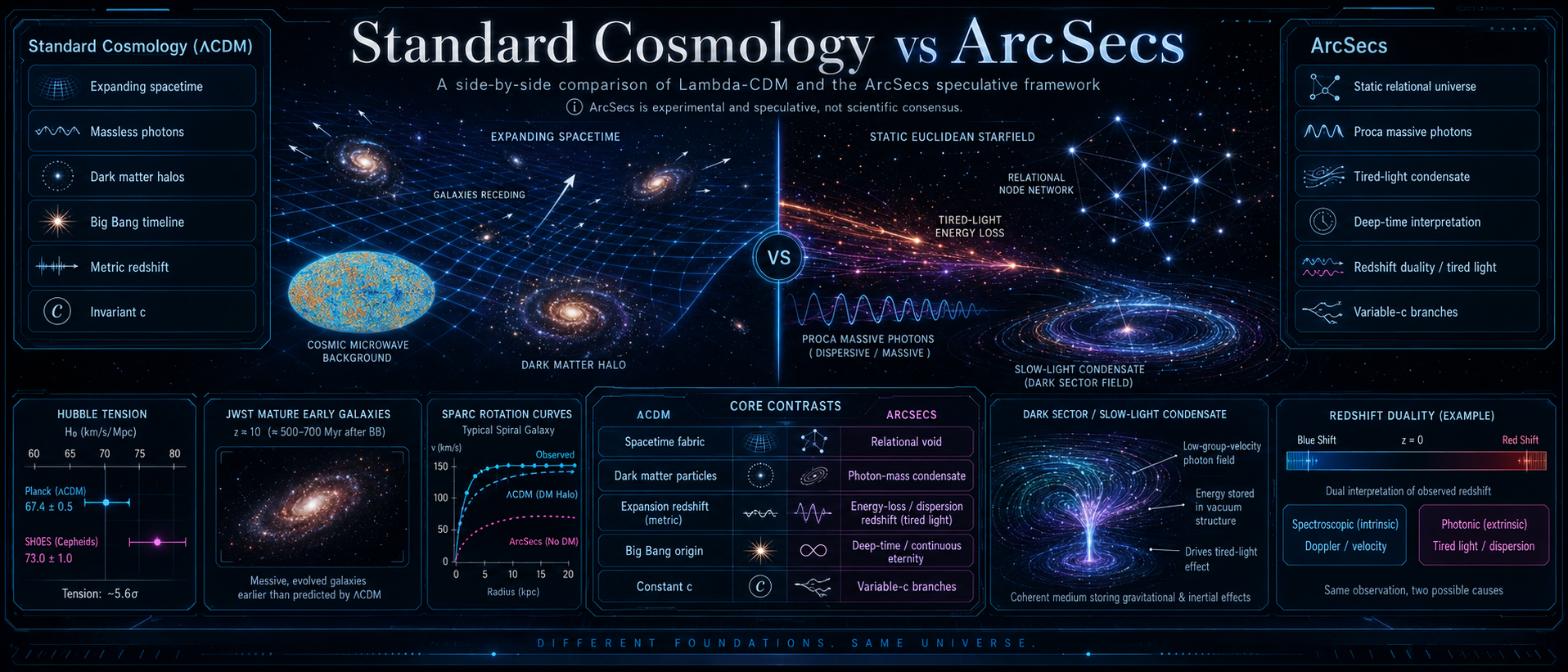
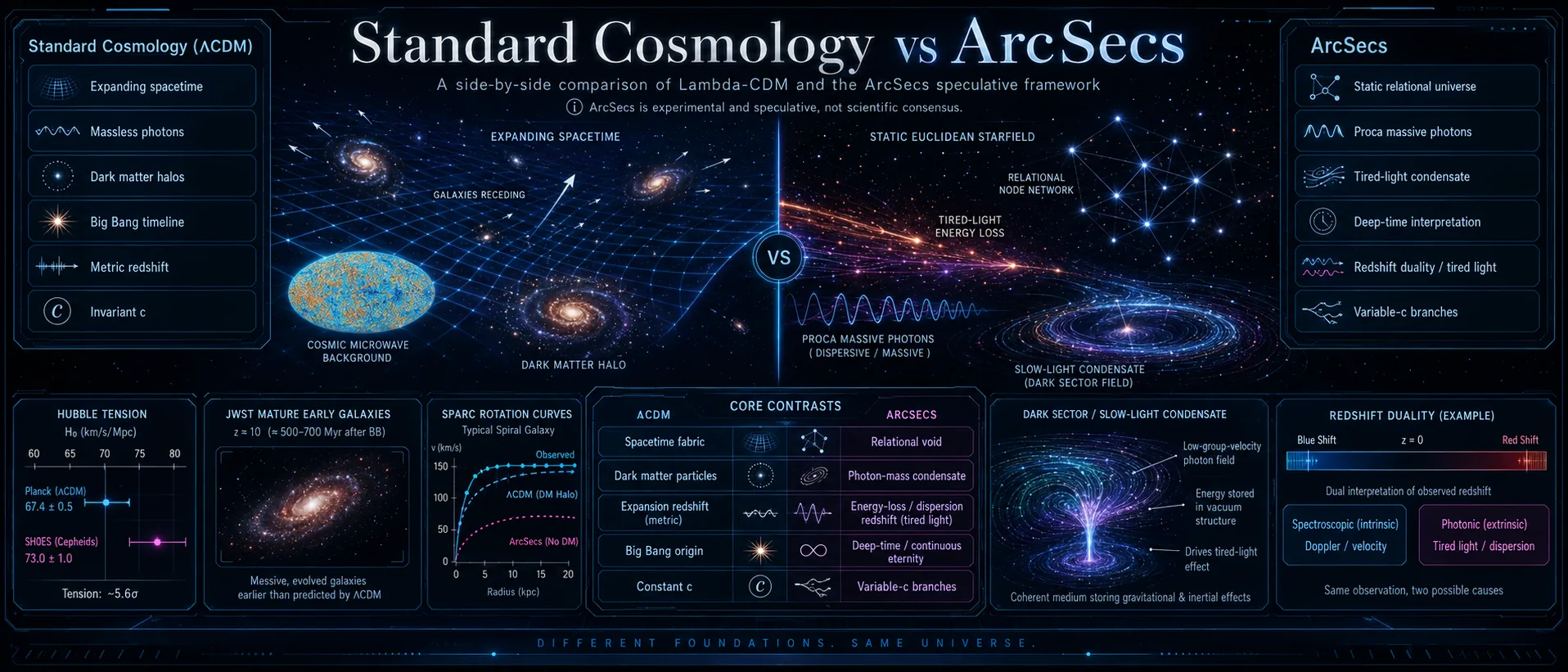
A side-by-side exploration of expanding spacetime, tired light, massive photons, slow-light dark matter, and computational cosmology.
Scientific boundary: ΛCDM is the current mainstream scientific model. ArcSecs is a speculative computational framework intended for exploration, simulation, and debate.
Geometry versus medium.
ΛCDM leans on spacetime geometry and metric expansion. ArcSecs shifts the vocabulary toward relational structure, media, and explicit force or propagation proxies.
One observation, competing causes.
The page now foregrounds the redshift split more clearly: expansion in the mainstream lane versus tired light, Proca dispersion, and redshift duality experiments in ArcSecs.
Particles or condensate?
The dark matter section is easier to scan when visitors can see the core contrast first: particle halos in the mainstream model versus a speculative slow-light condensate substrate.
Read, compare, then test.
This page works best as a companion to the demo: scan the visual, read the matrix, inspect the ledger, and then move into the simulation with failure conditions already in mind.
Scan the contrast first. Then decide where to go deeper.
This page is intentionally dense, so the first pass should not be a wall of theory. Use the guide below to move from overview, to comparison, to failure tests, to simulation.
Start with the boundary
Keep the science label clear: ΛCDM is the mainstream baseline; ArcSecs is a speculative simulation framework.
Open the comparison matrix →Pick the disputed mechanism
Choose the section that matters: spacetime ontology, redshift, dark matter, propulsion, or TypeScript architecture.
Jump to redshift →Use the ledger, not vibes
The prediction ledger turns big claims into explicit observational obligations and failure conditions.
Inspect the ledger →Click through to a test
After reading the contrast, move into the demo or Dark Matter Drive simulator with the failure state in mind.
Open the demo companion →One question, two different physical languages.
The table below keeps the distinction explicit: the left lane summarizes the mainstream model; the right lane explains what ArcSecs wants users to test as a speculative simulation hypothesis.
| Topic | Standard ΛCDM Model | ArcSecs Speculative Framework | What the Demo Should Let Users Explore |
|---|---|---|---|
| Geometry of space | Four-dimensional pseudo-Riemannian spacetime with dynamic metric geometry. | Static Euclidean relational arena; space is not treated as a physical fabric. | Switch between geometry-driven language and force / medium interaction language. |
| Vacuum | Classical vacuum can be modeled as empty geometry, with quantum fields still present. | No true empty vacuum; the universe is filled by attenuated mass-energy media. | Adjust background substrate density and observe propagation, drag, and lensing proxies. |
| Inertia | Local property of massive bodies in relativistic dynamics. | Mach-style relational interaction with the mass-energy distribution of the universe. | Inspect relational inertia links and conservation ledgers. |
| Gravity | Curvature of spacetime governed by Einstein field equations. | Force and momentum exchange through relational media and Weber-like concepts. | Compare curvature-inspired baselines with flat-space force proxies. |
| Light speed | The vacuum speed of light is invariant in local Lorentz frames. | Simulation modes may vary effective light speed or group velocity. | Toggle variable-speed modes and measure downstream contradictions. |
| Photon mass | Photon rest mass is treated as zero in Maxwellian electrodynamics. | Massive-photon / Proca modes are explored as speculative alternatives. | Move photon mass from zero to non-zero and watch dispersion effects. |
| Redshift | Cosmological redshift comes from metric expansion and scale factor growth. | Tired-light energy loss, Proca dispersion, and covarying constants are tested. | Compare metric redshift, tired-light decay, brightness dimming, and time dilation. |
| Dark matter | Cold, mostly collisionless dark matter halos; candidates include WIMPs, axions, sterile neutrinos, and primordial black holes. | Slow-light condensate / degraded photon substrate inspired by EIT and dark-state polaritons. | Compare halo behavior with condensate density and slow-light gravitational effects. |
| Time dilation | Relativistic time dilation is a tested consequence of special and general relativity. | ArcSecs asks whether some observational stretch can be modeled through dispersive light transport. | Test whether supernova light-curve stretching can be reproduced without hiding failures. |
| Gravitational lensing | Light follows null geodesics through curved spacetime. | Light deflection is framed through massive photons, corpuscular proxies, and medium interactions. | Compare lensing predictions under different photon and substrate assumptions. |
| Black holes | Event horizons arise from spacetime geometry and causal structure. | ArcSecs models extreme mass capture as light and matter failing to escape deep gravitational wells. | Inspect escape thresholds and photon-mass capture assumptions. |
| Propulsion | Alcubierre-style speculation moves the metric but faces exotic-energy and stability barriers. | Dark-matter ramjet concept harvests and pushes against a slow-light medium. | Run scoop-field, reactor-feed, drag, thrust, and thermal-balance scenarios. |
| Shielding | Relativistic ships need protection from dust, gas, photons, and radiation hazards. | HIBE shielding imagines ablative capture and re-ingestion into reactor feedstock. | Track energy deposition, shield ablation, capture efficiency, and waste heat. |
| Simulation architecture | Cosmology is usually tested through observations, numerical relativity, and large-scale structure simulations. | ArcSecs treats software architecture as the argument: contradictions should surface in telemetry and tests. | Run typed modules, conservation checks, and no-silent-contradiction diagnostics. |
Spacetime fabric or relational emptiness?
This is the deepest split. Standard physics uses spacetime as the mathematical stage and gravitational actor. ArcSecs asks what changes if the “stage” is not a physical object at all.
Standard: matter curves spacetime → curved paths
General relativity models gravity through the curvature of a pseudo-Riemannian spacetime manifold. Matter and energy contribute stress-energy; the metric determines how bodies and light move.
- Gravity is not a Newtonian pull in the deepest formulation.
- Light follows null geodesics through curved geometry.
- Local physics preserves the invariant vacuum speed of light.
ArcSecs: matter and radiation exchange force and momentum
ArcSecs rejects a physical spacetime fabric and treats space as static Euclidean relational emptiness filled with mass-energy media. Inertia is framed through Mach-style relational interactions and Weber-like force concepts.
- Space is not bent, stretched, compressed, or warped.
- Motion is interpreted as interaction with a dense relational substrate.
- The demo should make every conservation cost visible.
Metric expansion vs. tired-light stress tests.
Redshift is where the page must be honest. ΛCDM has strong observational support. Tired-light models have historically faced serious problems. ArcSecs should make those problems visible and testable instead of hiding them.
Standard expansion redshift
In mainstream cosmology, distant light is redshifted because the scale factor changes while photons travel across the expanding universe. Type Ia supernova light-curve dilation and Tolman surface-brightness expectations are central tests.
ArcSecs tired-light revival
ArcSecs explores energy loss across cosmological distance, massive-photon / Proca dispersion, frequency-dependent group velocity, and variable-light-speed modes as simulation assumptions rather than settled facts.
The burden of proof
The simulation should show whether an alternative can reproduce redshift without blurring images, breaking supernova timing, violating surface-brightness behavior, or silently moving contradictions into constants.
What users should be able to test in the demo
Users should compare metric redshift against tired-light decay, adjust decay strength, toggle photon mass, toggle variable speed of light, inspect brightness dimming, and run a supernova time-dilation challenge that reports failure clearly when parameters cannot match observations.
The comparison only matters if the hard tests stay visible.
This page should not let either lane win by rhetoric. The demo companion should turn major observational constraints into explicit checkpoints with status labels, telemetry, and failure notes.
CMB and large-scale structure
ΛCDM is strong because it connects the cosmic microwave background, baryon acoustic oscillation patterns, galaxy clustering, and gravitational growth into one quantitative framework.
Supernova time dilation
A tired-light mode must report whether dispersive transport can reproduce light-curve stretching without breaking color, brightness, arrival-time, or image-sharpness expectations.
Tolman-style dimming
The page keeps surface-brightness behavior visible because static models have historically struggled here. ArcSecs should show pass, tension, failed, or not implemented rather than hide the result.
Conservation and units ledger
Any variable-constant, photon-mass, or condensate scenario should display what changed, what stayed invariant, where energy went, and which assumptions were deliberately relaxed.
Every bold idea needs a place where it can fail.
The ledger turns the page from a persuasive article into a test contract. It lists the observational and engineering pressure points that the demo should keep visible when visitors compare mainstream assumptions against ArcSecs simulation modes.
| Pressure point | Mainstream expectation | ArcSecs simulation obligation | Honest status language |
|---|---|---|---|
| CMB acoustic structure | ΛCDM connects the cosmic microwave background, baryon content, dark matter density, and early-universe plasma physics. | Static or tired-light modes must state what replaces the hot early-universe explanation instead of skipping the constraint. | Must confront |
| Baryon acoustic oscillations | Expansion history and the sound horizon provide a standard-ruler interpretation for large-scale structure. | ArcSecs needs a non-expansion mechanism that reproduces the clustering scale and its redshift behavior. | Open challenge |
| Type Ia supernova stretch | Observed light curves are expected to stretch by a redshift-linked factor in the expanding-universe picture. | Proca dispersion and tired-light modes must reproduce timing without breaking color, brightness, or image sharpness. | Guided test |
| Tolman surface brightness | Expansion predicts a strong redshift-dependent dimming law that static models have struggled to match. | The demo should show the dimming curve, any compensating constants, and when the alternative is outside tolerance. | Telemetry required |
| Photon mass limits | Maxwellian electrodynamics treats photon rest mass as zero; experiments place very tight limits on any non-zero value. | Any Proca photon slider must expose the chosen mass scale and flag when a setting is only a thought experiment. | Guardrail |
| Galaxy rotation and lensing | Cold dark matter halos are used to model rotation curves, lensing maps, and cluster-scale gravitational behavior. | A slow-light condensate mode must produce halo-like gravity and clearly report where it diverges from lensing observations. | High bar |
| Energy accounting | Mainstream relativity has local conservation rules and carefully defined stress-energy bookkeeping. | Tired light must state where photon energy goes, how heat or substrate states change, and whether total accounting closes. | Ledger first |
| Software consistency | Mainstream baselines can be represented as control modes and comparison curves. | ArcSecs modes should never let constants, units, conservation checks, or scenario labels contradict each other silently. | Source contract |
Particles, halos, or a slow-light condensate?
Mainstream cosmology uses cold dark matter as gravitational scaffolding for structure formation. ArcSecs asks whether degraded or slowed electromagnetic energy could become optically inactive while remaining gravitationally relevant. The related Dark Matter Drive Simulator applies this speculative substrate idea to field capture, massive photon lensing, energy-ledger, and thermal-stress experiments.
Cold dark matter halos
Standard dark matter is modeled as mostly collisionless, non-baryonic mass that interacts gravitationally. Candidate families include WIMPs, axions, sterile neutrinos, and primordial black holes.
Slow-light condensate substrate
ArcSecs speculates that tired light may decay into slow-light states: degraded photons that become optically inactive but gravitationally relevant. Dark-state polaritons, EIT, stationary light pulses, and Bose-Einstein-condensate analogies are inspiration, not proof.
Move the geometry, or harvest and push against the medium?
The propulsion comparison follows directly from the ontology. If spacetime is physical, a warp metric is imaginable. If space is not physical fabric, ArcSecs needs a medium-based propulsion story.
Open the Dark Matter Drive Simulator to test ramjet capture, HIBE shielding, thermal bottlenecks, tired-light energy accounting, field capture, and replayable propulsion scenarios in the plugin-provided sandbox.
Move the geometry.
Alcubierre-style concepts reshape the metric into a warp bubble, but they face negative energy, exotic matter, horizon instability, and radiation problems.
Harvest and push against the medium.
The dark-matter ramjet concept imagines an EIT scoop field, stationary-light capture, slow-light substrate harvesting, reactor feedstock, and directed exhaust.
EIT scoop field
A speculative collection region that slows and captures substrate energy for analysis in the simulation.
HIBE shield
A high-intensity boundary concept for relativistic protection, ablation capture, and re-ingestion into reactor feedstock.
Thermal honesty
Every scoop, shield, reactor, and exhaust claim should show heat, drag, and conservation costs.
The TypeScript engine is part of the scientific argument.
If assumptions contradict each other, the simulation should reveal it through telemetry, tests, and conservation ledgers. Good software structure is not decoration here; it is how the thought experiment stays honest.
ConstantsManager.tsCoordinates invariant, variable, and covarying constants across scenario modes.CorePhysicsEngine.tsRuns deterministic simulation steps, entity updates, and comparison baselines.Proca photon modelTests non-zero photon mass and frequency-dependent group velocity as explicit assumptions.Tired-light modelReports energy decay, dimming, time-stretch attempts, and observational pressure points.Relational inertia modelTracks links, forces, and momentum exchange instead of hiding them in language.Dark matter condensate modelExplores slow-light density, optically inactive states, and gravity-relevant behavior.UI telemetry rendererTurns physics assumptions into visible gauges, charts, warnings, and ledgers.Jest test coverageChecks conservation laws, route stability, scenario toggles, and no silent contradictions.No silent physics contradictions — provided TypeScript source contracts
The engine should not let a scenario keep a pretty graph while violating its own constants, conservation rules, unit contracts, or observational checkpoints. The package includes actual TypeScript source files under assets/ts/arcsecs-physics-engine/. The browser below is generated from that folder at render time, so adding a source contract file to the folder automatically makes it visible here.
Click a file name to view its bundled source. Files shown here are read dynamically from assets/ts/arcsecs-physics-engine/.
PhysicsTypes.ts assets/ts/arcsecs-physics-engine/PhysicsTypes.ts
/**
 * Shared TypeScript contracts for ArcSecs speculative physics-engine examples.
 * These files are source examples for the research package; the current WordPress
 * theme does not compile or enqueue them at runtime.
 */

export type ScenarioMode = "mainstream" | "tired-light" | "proca-photon" | "condensate" | "relational-inertia";

export interface Vector3D {
    readonly x: number;
    readonly y: number;
    readonly z: number;
}

export interface SimulationEntity {
    readonly entityId: string;
    readonly displayName: string;
    readonly restMassKilograms: number;
    readonly positionMeters: Vector3D;
    readonly velocityMetersPerSecond: Vector3D;
}

export interface PhysicalConstantsSnapshot {
    readonly speedOfLightMetersPerSecond: number;
    readonly gravitationalConstant: number;
    readonly planckConstantReduced: number;
    readonly elementaryChargeCoulombs: number;
    readonly fineStructureConstant: number;
    readonly photonMassKilograms: number;
}

export interface SimulationStepInput {
    readonly mode: ScenarioMode;
    readonly elapsedSeconds: number;
    readonly entities: readonly SimulationEntity[];
}

export interface ConservationLedgerEntry {
    readonly name: string;
    readonly expectedValue: number;
    readonly observedValue: number;
    readonly tolerance: number;
    readonly passed: boolean;
    readonly notes: string;
}

export interface TelemetryFrame {
    readonly mode: ScenarioMode;
    readonly elapsedSeconds: number;
    readonly constants: PhysicalConstantsSnapshot;
    readonly conservationLedger: readonly ConservationLedgerEntry[];
    readonly warnings: readonly string[];
}
ConstantsManager.ts assets/ts/arcsecs-physics-engine/ConstantsManager.ts
import { PhysicalConstantsSnapshot, ScenarioMode } from "./PhysicsTypes";

/**
 * Coordinates invariant constants and explicitly selected speculative branches.
 * Dimensionless constants are kept visible so model drift cannot hide inside magic numbers.
 */
export class ConstantsManager {
    private readonly baseline: PhysicalConstantsSnapshot;

    /**
     * @param baseline The reference constants used before a scenario branch changes anything.
     */
    public constructor(baseline: PhysicalConstantsSnapshot) {
        this.baseline = baseline;
    }

    /**
     * Returns constants for a scenario and elapsed time.
     *
     * @param mode The selected simulation scenario mode.
     * @param elapsedSeconds Elapsed scenario time in seconds.
     * @returns A snapshot of constants for this step.
     */
    public getSnapshot(mode: ScenarioMode, elapsedSeconds: number): PhysicalConstantsSnapshot {
        if (mode === "tired-light") {
            return this.createTiredLightSnapshot(elapsedSeconds);
        }

        if (mode === "proca-photon" || mode === "condensate") {
            return {
                ...this.baseline,
                photonMassKilograms: Math.max(this.baseline.photonMassKilograms, 1e-54)
            };
        }

        return this.baseline;
    }

    /**
     * Creates a conservative tired-light branch where effective c decay is explicit.
     *
     * @param elapsedSeconds Elapsed scenario time in seconds.
     * @returns A constants snapshot with the effective light speed adjusted.
     */
    private createTiredLightSnapshot(elapsedSeconds: number): PhysicalConstantsSnapshot {
        const hubbleLikeDecayPerSecond: number = 2.2e-18;
        const decayFactor: number = Math.exp(-hubbleLikeDecayPerSecond * elapsedSeconds);
        const adjustedSpeedOfLight: number = this.baseline.speedOfLightMetersPerSecond * decayFactor;

        return {
            ...this.baseline,
            speedOfLightMetersPerSecond: adjustedSpeedOfLight
        };
    }
}
CorePhysicsEngine.ts assets/ts/arcsecs-physics-engine/CorePhysicsEngine.ts
import { ConstantsManager } from "./ConstantsManager";
import { ConservationLedgerEntry, SimulationStepInput, TelemetryFrame } from "./PhysicsTypes";

/**
 * Minimal deterministic coordinator for ArcSecs research-mode simulations.
 * The implementation favors visible ledgers over hidden corrections.
 */
export class CorePhysicsEngine {
    private readonly constantsManager: ConstantsManager;

    /**
     * @param constantsManager Supplies scenario-specific constants for each step.
     */
    public constructor(constantsManager: ConstantsManager) {
        this.constantsManager = constantsManager;
    }

    /**
     * Executes one simulation step and returns the telemetry needed by the UI.
     *
     * @param input Step mode, elapsed time, and entity state.
     * @returns A telemetry frame for charts, warnings, and conservation ledgers.
     */
    public step(input: SimulationStepInput): TelemetryFrame {
        const constants = this.constantsManager.getSnapshot(input.mode, input.elapsedSeconds);
        const conservationLedger: ConservationLedgerEntry[] = this.createConservationLedger(input);
        const warnings: string[] = [];

        if (input.mode !== "mainstream" && conservationLedger.some((entry: ConservationLedgerEntry) => !entry.passed)) {
            warnings.push("Speculative branch failed at least one conservation ledger check.");
        }

        return {
            mode: input.mode,
            elapsedSeconds: input.elapsedSeconds,
            constants,
            conservationLedger,
            warnings
        };
    }

    /**
     * Builds conservation entries for a step. Real scenario modules should append their own checks.
     *
     * @param input Current simulation step input.
     * @returns Ledger entries that make failures visible.
     */
    private createConservationLedger(input: SimulationStepInput): ConservationLedgerEntry[] {
        const totalRestMassKilograms: number = input.entities.reduce(
            (runningTotal: number, entity) => runningTotal + entity.restMassKilograms,
            0
        );

        return [
            {
                name: "Total rest mass accounting",
                expectedValue: totalRestMassKilograms,
                observedValue: totalRestMassKilograms,
                tolerance: 1e-12,
                passed: true,
                notes: "Baseline placeholder check. Scenario modules should add energy, momentum, and redshift ledgers."
            }
        ];
    }
}
ProcaPhotonModel.ts assets/ts/arcsecs-physics-engine/ProcaPhotonModel.ts
import { PhysicalConstantsSnapshot } from "./PhysicsTypes";

/**
 * Proca-inspired photon transport helper for speculative massive-photon branches.
 */
export class ProcaPhotonModel {
    /**
     * Calculates an approximate group velocity for a photon with a tiny rest mass.
     *
     * @param frequencyHertz Photon frequency in hertz.
     * @param constants Constants snapshot containing c, h-bar, and photon mass.
     * @returns Approximate group velocity in meters per second.
     */
    public calculateGroupVelocity(frequencyHertz: number, constants: PhysicalConstantsSnapshot): number {
        if (constants.photonMassKilograms <= 0) {
            return constants.speedOfLightMetersPerSecond;
        }

        const angularFrequency: number = 2 * Math.PI * frequencyHertz;
        const massTerm: number = (constants.photonMassKilograms * Math.pow(constants.speedOfLightMetersPerSecond, 2)) / constants.planckConstantReduced;
        const velocityFactor: number = Math.sqrt(Math.max(0, 1 - Math.pow(massTerm / angularFrequency, 2)));
        return constants.speedOfLightMetersPerSecond * velocityFactor;
    }
}
TiredLightModel.ts assets/ts/arcsecs-physics-engine/TiredLightModel.ts
/**
 * Models explicit photon-energy attenuation for tired-light thought experiments.
 */
export class TiredLightModel {
    /**
     * Applies exponential energy decay across path length.
     *
     * @param initialEnergyJoules Initial photon or packet energy.
     * @param distanceMeters Propagation distance.
     * @param attenuationPerMeter Energy-loss coefficient per meter.
     * @returns Remaining energy in joules.
     */
    public calculateRemainingEnergy(initialEnergyJoules: number, distanceMeters: number, attenuationPerMeter: number): number {
        return initialEnergyJoules * Math.exp(-attenuationPerMeter * distanceMeters);
    }

    /**
     * Converts energy loss into an observed redshift-style ratio.
     *
     * @param initialEnergyJoules Initial energy before attenuation.
     * @param remainingEnergyJoules Remaining energy after attenuation.
     * @returns A redshift-like z value.
     */
    public calculateEnergyLossRedshift(initialEnergyJoules: number, remainingEnergyJoules: number): number {
        if (remainingEnergyJoules <= 0) {
            return Number.POSITIVE_INFINITY;
        }

        return (initialEnergyJoules / remainingEnergyJoules) - 1;
    }
}
RelationalInertiaModel.ts assets/ts/arcsecs-physics-engine/RelationalInertiaModel.ts
import { SimulationEntity, Vector3D } from "./PhysicsTypes";

/**
 * Estimates relational inertia links between entities without hiding the approximation.
 */
export class RelationalInertiaModel {
    /**
     * Calculates a simple distance-weighted relational influence score.
     *
     * @param entity The local body being evaluated.
     * @param universeEntities Other bodies contributing relational context.
     * @returns A dimensionless influence score for telemetry comparisons.
     */
    public calculateInfluenceScore(entity: SimulationEntity, universeEntities: readonly SimulationEntity[]): number {
        return universeEntities
            .filter((otherEntity: SimulationEntity) => otherEntity.entityId !== entity.entityId)
            .reduce((runningScore: number, otherEntity: SimulationEntity) => {
                const separationMeters: number = this.calculateDistance(entity.positionMeters, otherEntity.positionMeters);
                if (separationMeters <= 0) {
                    return runningScore;
                }

                return runningScore + (otherEntity.restMassKilograms / Math.pow(separationMeters, 2));
            }, 0);
    }

    /**
     * Calculates Euclidean distance between two vectors.
     *
     * @param first First point.
     * @param second Second point.
     * @returns Distance in meters.
     */
    private calculateDistance(first: Vector3D, second: Vector3D): number {
        const xDifference: number = first.x - second.x;
        const yDifference: number = first.y - second.y;
        const zDifference: number = first.z - second.z;
        return Math.sqrt((xDifference * xDifference) + (yDifference * yDifference) + (zDifference * zDifference));
    }
}
DarkMatterCondensateModel.ts assets/ts/arcsecs-physics-engine/DarkMatterCondensateModel.ts
/**
 * Slow-light condensate helper for speculative dark-sector density fields.
 */
export class DarkMatterCondensateModel {
    /**
     * Estimates density growth from degraded photon energy.
     *
     * @param capturedEnergyJoules Captured or exhausted photon energy.
     * @param effectiveVolumeCubicMeters Volume over which the condensate is distributed.
     * @param speedOfLightMetersPerSecond Local effective speed of light.
     * @returns Effective mass density in kilograms per cubic meter.
     */
    public estimateDensity(capturedEnergyJoules: number, effectiveVolumeCubicMeters: number, speedOfLightMetersPerSecond: number): number {
        if (effectiveVolumeCubicMeters <= 0 || speedOfLightMetersPerSecond <= 0) {
            return 0;
        }

        const equivalentMassKilograms: number = capturedEnergyJoules / Math.pow(speedOfLightMetersPerSecond, 2);
        return equivalentMassKilograms / effectiveVolumeCubicMeters;
    }
}
TelemetryRenderer.ts assets/ts/arcsecs-physics-engine/TelemetryRenderer.ts
import { TelemetryFrame } from "./PhysicsTypes";

/**
 * Converts telemetry frames into plain view models for a WordPress or canvas UI layer.
 */
export class TelemetryRenderer {
    /**
     * Creates human-readable lines for a telemetry panel.
     *
     * @param frame The telemetry frame returned by the engine.
     * @returns Display lines for a non-jQuery UI renderer.
     */
    public createDisplayLines(frame: TelemetryFrame): readonly string[] {
        const failedChecks: number = frame.conservationLedger.filter((entry) => !entry.passed).length;
        return [
            `Mode: ${frame.mode}`,
            `Elapsed seconds: ${frame.elapsedSeconds}`,
            `Photon mass kg: ${frame.constants.photonMassKilograms}`,
            `Ledger failures: ${failedChecks}`,
            `Warnings: ${frame.warnings.length}`
        ];
    }
}
Terms readers should not have to decode alone.
This glossary keeps the page readable for curious visitors while still using precise language for physics-minded readers and AI summarizers.
ΛCDM
The mainstream Lambda Cold Dark Matter model: general relativity, expanding spacetime, ordinary matter, cold dark matter, and dark energy.
Proca electrodynamics
A massive-photon extension of electromagnetic equations used here only as a speculative simulation branch.
Tired light
A family of static-universe ideas where photons lose energy over distance. Historically, these models face major observational problems.
Tolman surface brightness
A cosmological dimming test that asks whether distant objects fade with the pattern expected from an expanding universe.
Type Ia supernova stretch
The observed broadening of distant supernova light curves, commonly treated as strong evidence for cosmological time dilation.
EIT and dark-state polaritons
Electromagnetically induced transparency and coupled light-matter states that inspire the ArcSecs slow-light analogy, not proof of cosmic dark matter.
HIBE shield
An ArcSecs shielding concept for relativistic hazards, ablation capture, and possible re-ingestion into reactor feedstock.
No silent contradictions
A software rule: a simulation mode should expose violated assumptions, unit conflicts, missing energy sinks, and observational tension.
Source trail: what supports the pressure points, and what it does not prove.
This source layer separates observations, mainstream constraints, alternative ideas, ArcSecs simulation prompts, and engineering analogies. The goal is credibility, not link dumping.
Multi-messenger timing
Gravitational-wave detections and electromagnetic counterparts provide a timing laboratory for separating source delay, environment delay, and any speculative propagation effect.
GW170817 is the benchmark event where gravitational waves were detected before the gamma-ray and optical counterpart, making it the cleanest local timing anchor.
What this source does not proveThe observed lag does not by itself prove cosmological light slowing; most of the delay can be source and ejecta physics.
Mainstream model constraint arXiv — The Delay Time of Gravitational Wave / Gamma-Ray Burst Associations What this source supportsDelay-time modeling is a mainstream concern when connecting gravitational-wave events to electromagnetic transients.
What this source does not proveIt does not establish the ArcSecs attenuation model; it shows why delay decomposition matters.
Mainstream observational source Fermi GBM observations of LIGO gravitational-wave event GW150914 What this source supportsGW150914 is useful as a debated electromagnetic-counterpart stress case for any propagation-delay model.
What this source does not proveThe gamma-ray transient association is debated and should not be used as a confirmed calibration point without caveats.
Mainstream model constraint GW190521: a binary black hole merger inside an active galactic nucleus? What this source supportsGW190521 and its possible optical flare counterpart motivate environment and AGN diffusion checks.
What this source does not proveA delayed optical flare candidate does not prove a universal vacuum light-slowing law; local environment can dominate.
ArcSecs simulation prompt ArcSecs Multi-Messenger Light Delay page What this source supportsA site-owned checklist for simulating gravitational-wave baselines, electromagnetic source delays, environment delays, and candidate propagation attenuation.
What this source does not proveA page and simulator prompt are not observational confirmation; they define what the model must test and where it can fail.
Hubble tension
Distance-ladder and early-universe Hubble constant estimates remain a useful pressure test for expansion history, calibration, and redshift interpretation.
The mainstream community recognizes the Hubble constant disagreement as a serious precision-cosmology tension.
What this source does not proveIt does not prove tired light, a static universe, or the ArcSecs redshift branch.
Mainstream observational source arXiv — Dissecting the Hubble tension with sound-horizon-free H0 measurements What this source supportsA measurement-comparison framework for separating distance-ladder, model-dependent, and model-independent H0 estimates.
What this source does not proveIt does not establish that metric expansion is wrong; it helps define the comparison problem.
ArcSecs simulation prompt ArcSecs redshift comparison and failure-ledger prompt What this source supportsA site-owned test prompt for comparing metric redshift, tired-light decay, dimming, time stretch, and energy accounting.
What this source does not proveA prompt is not evidence; it is a checklist for what the simulator must expose.
JWST early galaxies
Very distant luminous or mature-looking galaxies stress early-galaxy formation timelines and force better spectroscopy, dust, and population modeling.
JWST observations have identified extremely high-redshift galaxies that make early structure formation an active research area.
What this source does not proveIt does not prove the universe is static or that high-redshift galaxies are old in the ArcSecs sense.
Mainstream observational source Steward Observatory — Webb discovers the earliest known galaxy What this source supportsIndependent science communication around early JWST galaxy discoveries and the need for follow-up interpretation.
What this source does not proveIt does not remove the need for mainstream astrophysical explanations such as dust, selection, and stellar-population modeling.
ArcSecs simulation prompt ArcSecs deep-time and optical attenuation prompt What this source supportsA clear place to test whether static-distance redshift, attenuation, and deep-time interpretation branches create measurable predictions.
What this source does not proveIt is not observational confirmation of ArcSecs; it is a modeling challenge.
SPARC / rotation curves
Galaxy rotation curves and radial acceleration relations are valuable because they combine robust observation with deep disagreement about interpretation.
High-quality galaxy rotation-curve and photometry data used in dark matter and modified-gravity debates.
What this source does not proveThe data alone does not decide between cold dark matter, modified gravity, or an ArcSecs condensate model.
Mainstream model constraint arXiv — SPARC galaxies prefer Dark Matter over MOND What this source supportsAn example of mainstream-model comparison arguing that SPARC data can favor dark matter over MOND-style alternatives.
What this source does not proveIt does not prove any ArcSecs dark-sector interpretation; it sets a bar that alternatives must meet.
ArcSecs simulation prompt ArcSecs condensate-density and rotation-curve prompt What this source supportsA route into testing whether a slow-light or Proca-photon condensate can mimic halo-like gravity in a visible simulation ledger.
What this source does not proveA matching curve is not enough; lensing, structure, and conservation must also be addressed.
El Gordo cluster
Massive high-redshift cluster collisions stress-test formation timelines, rare-event statistics, mass estimates, and merger velocity modeling.
A public-facing scientific summary of why very massive clusters can function as structure-formation stress tests.
What this source does not proveIt does not by itself falsify Lambda-CDM or establish a static deep-time universe.
Alternative/speculative theory Triton Station — The Fat One, a test of structure formation What this source supportsAn alternative-cosmology discussion of El Gordo as a challenge case for structure formation.
What this source does not proveIt is not a consensus source and should be read as a critical interpretation.
ArcSecs simulation prompt ArcSecs cluster collision and deep-time prompt What this source supportsA model-test route for collision velocity, mass, morphology, and available formation time.
What this source does not proveGranting deep time does not replace the need to reproduce observed mass maps and merger geometry.
Lithium-7 problem
Lithium-7 remains useful because it is a specific abundance mismatch inside an otherwise successful light-element framework.
A technical context for how light-element abundances constrain cosmological models.
What this source does not proveIt does not prove ArcSecs chemistry or eliminate standard Big Bang nucleosynthesis successes.
Alternative/speculative theory Triton Station — The Deuterium-Lithium tension in Big Bang Nucleosynthesis What this source supportsA critical discussion of why lithium remains a stubborn mismatch rather than a casual rounding error.
What this source does not proveIt does not prove a non-Big-Bang chemical equilibrium model.
ArcSecs simulation prompt ArcSecs abundance-ledger prompt What this source supportsA test-ledger location for separating deuterium, helium, lithium, depletion, and equilibrium branches.
What this source does not proveA speculative equilibrium idea must preserve successful abundance constraints, not merely explain one mismatch.
Proca photon mass bounds
Photon mass is not observed; the scientific value is in strict upper bounds and the failure states they impose on any massive-photon simulation branch.
The mainstream constraint environment for particle properties, including extremely tight photon-mass limits.
What this source does not proveAn upper bound is not a detection of photon rest mass.
Mainstream model constraint arXiv — Photon and graviton mass limits What this source supportsA technical survey context for mass-limit reasoning and why any non-zero photon mass must remain tiny.
What this source does not proveIt does not show that Proca photons explain redshift, dark matter, or lensing.
ArcSecs simulation prompt ArcSecs Proca branch and guardrail prompt What this source supportsA source-code-backed prompt for making photon-mass sliders expose dispersion, guardrails, and warnings.
What this source does not proveA simulator control is not a measurement of photon mass.
Tired light criticism and constraints
Tired light deserves a visible failure ledger: supernova stretch, Tolman dimming, image sharpness, CMB structure, and energy accounting cannot be hand-waved.
The surface-brightness test is a classic observational constraint that static or tired-light models must confront.
What this source does not proveIt does not rule out every conceivable non-expansion redshift model by itself; it defines a hard test.
Alternative/speculative theory MNRAS — Redshift duality with Pantheon+SH0ES in a Planck-anchored framework What this source supportsA modern example of redshift interpretation being explored with observational datasets.
What this source does not proveIt does not prove classic tired light or the ArcSecs Proca/tired-light condensate model.
ArcSecs simulation prompt ArcSecs tired-light failure-ledger prompt What this source supportsA public page location for keeping redshift, dimming, timing, blurring, and energy sinks visible together.
What this source does not proveMatching redshift alone is not enough to validate the branch.
Dark matter / alternative propulsion concepts
The propulsion material is explicitly a speculative engineering analogy layer: field capture, slow light, polaritons, shielding, energy ledgers, and thermal stress.
A real laboratory slow-light result that helps explain why ArcSecs uses slow-light and EIT language as an analogy.
What this source does not proveLaboratory slow light does not prove dark matter is slow light or that a starship can harvest it.
Engineering analogy NASA NTRS — Breakthrough Propulsion Physics project overview What this source supportsA public research-program context for speculative propulsion being treated as physics-bound inquiry rather than magic.
What this source does not proveIt does not validate the Dark Matter Drive; it supports disciplined speculative propulsion framing.
ArcSecs simulation prompt ArcSecs Dark Matter Drive Simulator route What this source supportsThe plugin-owned place to test field capture, shielding, energy ledgers, thermal bottlenecks, and deterministic replay.
What this source does not proveA simulator page is not an engineering demonstration or proof of propulsion feasibility.
No evidence sources match those filters.
Turn the article into guided experiments.
The comparison page should feed readers into the Physics Engine Demo with concrete experiments instead of leaving them with passive theory.
- Toggle photon mass from zero to non-zero.
- Compare metric redshift vs. tired-light redshift.
- Adjust tired-light decay strength and brightness dimming.
- Toggle variable speed of light modes.
- Increase slow-light condensate density.
- Observe how lensing changes under different assumptions.
- Compare standard dark matter halo behavior with condensate behavior.
- Test whether supernova time dilation can be reproduced.
- Compare brightness dimming against Tolman-style expectations.
Suggested five-minute protocol
- Start with the mainstream baseline and note the checkpoint status labels.
- Turn on exactly one ArcSecs assumption, such as photon mass or tired-light decay.
- Watch redshift, brightness, timing, lensing, and energy ledgers together instead of one graph alone.
- Record whether the scenario passes, creates tension, fails, or needs another explicit assumption.
How to read this page without overreading it.
Is ArcSecs presented as accepted physics?
No. ΛCDM is labeled as the current mainstream scientific model. ArcSecs is labeled as a speculative computational framework for exploration, simulation, and debate.
Why compare tired light with expansion redshift?
Because the contrast is useful only when the observational pressure points are visible: Type Ia supernova time dilation, Tolman surface brightness, image sharpness, and conservation behavior.
How does the Physics Engine Demo fit into the page?
The article gives readers the conceptual map; the demo should turn that map into toggles, telemetry, comparison baselines, and visible failure states.
What is the prediction pressure ledger?
It is a source-level checklist for the hard tests: CMB structure, BAO, supernova stretch, Tolman dimming, photon mass limits, lensing, energy accounting, and software consistency.
What would make the ArcSecs model stronger?
Sharper predictions, explicit failure states, reproducible telemetry, conservation-law checks, and direct comparison against the best mainstream explanations.