
Gravity detected first. Light seen later. What does that really test?
A report-based ArcSecs page for separating gravitational-wave baselines, electromagnetic source delays, environmental diffusion, and the speculative light-slowing / tired-light propagation branch.
Scientific boundary: multi-messenger astronomy is real observational science. The ArcSecs interpretation on this page is speculative and should be treated as a model to test, not a settled replacement for mainstream relativity or astrophysics.
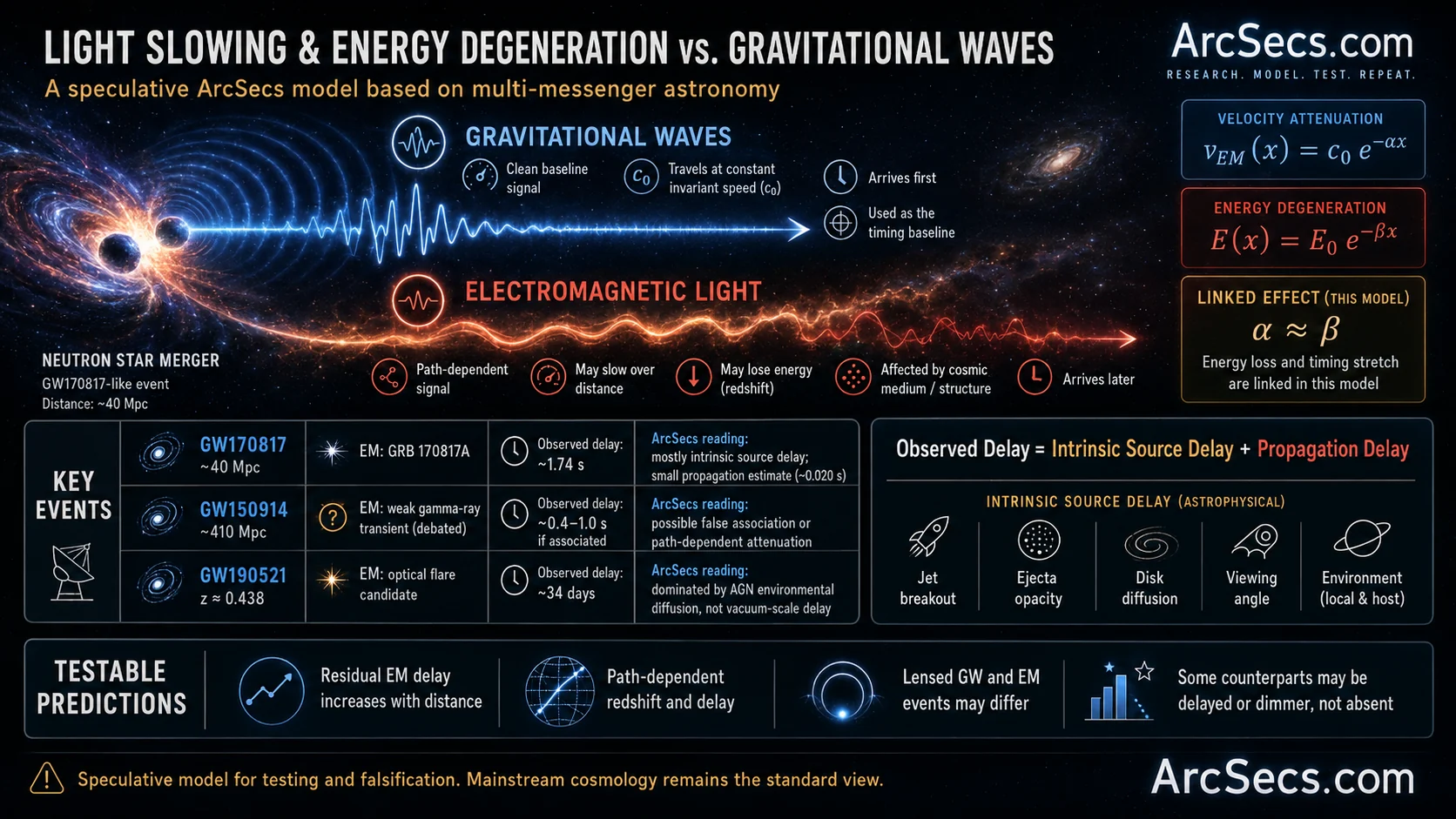
The page is not saying every delay is pure slow light.
The useful claim is narrower: gravitational waves create a clean timing baseline, while electromagnetic counterparts carry source physics, environmental opacity, and any possible propagation effect together.
Observation
Several candidate multi-messenger readings show gravitational-wave signals detected before electromagnetic light or candidate counterparts.
Mainstream caveat
Most of the measured lag is usually explained by source delay, jet breakout, ejecta opacity, association uncertainty, or AGN environment diffusion.
ArcSecs test
The speculative branch asks whether a tiny residual propagation component can be modeled as path-dependent electromagnetic slowing and energy degeneration.
Failure condition
If a simple slowing law breaks GW150914, supernova timing, lensing, brightness, or image sharpness, the simulator must say so visibly.
Three timing cases, three very different caveats.
The event cards keep observed timing separate from interpretation. That makes the page harder to misuse as a slogan and more useful as a simulator checklist.
GW170817
- Source
- Binary neutron star merger
- Distance
- ~40 Mpc
- EM counterpart
- GRB 170817A / kilonova
- Observed lag
- 1.74 seconds
Best local anchor: gravity-wave timing arrives first, while most of the electromagnetic lag is treated as source/ejecta delay. The uploaded report estimates only a small propagation component.
GW150914
- Source
- Binary black hole merger
- Distance
- ~410 Mpc
- EM counterpart
- Weak gamma-ray transient, debated
- Observed lag
- ~0.4 seconds if associated
Useful stress test because the electromagnetic association is debated and a simple universal slowing law does not fit cleanly without path-density or false-association caveats.
GW190521
- Source
- Massive binary black hole merger
- Distance
- ~5.3 Gpc nominal
- EM counterpart
- Optical flare candidate in AGN environment
- Observed lag
- ~34 days
The long delay is framed mainly as AGN/accretion-disk environment diffusion rather than pure vacuum propagation delay.
Use diagrams to keep the model honest.
The uploaded graphics are now part of the page so visitors can understand the timing claim visually before reading the dense model logic.


Turn the diagrams into falsifiable simulator work.
The page translates the uploaded report into controls the simulation should expose instead of letting the article become a static claim.
Separate delay buckets
Render observed delay as source delay + environment delay + candidate propagation delay. Do not hide the decomposition.
Path-density coefficient
Allow electromagnetic attenuation to vary with line-of-sight density instead of assuming one universal slowing constant.
Energy ledger
When tired-light energy degeneration is enabled, show where the photon energy is assumed to go.
Causality guardrail
Positive electromagnetic lag does not automatically violate causality; the simulator should explain that distinction explicitly.
Lensing test
Future lensed multi-messenger events should be treated as a major pass/fail branch for differential GW versus EM delays.
Counterpart uncertainty
Debated electromagnetic counterparts must be labeled as debated, not silently treated as confirmed calibration points.
Where this page connects to the rest of ArcSecs.
Use this page as the timing bridge between the cosmology comparison, anomalies tracker, source library, and simulation pages.
Source trail: what supports the pressure points, and what it does not prove.
This source layer separates observations, mainstream constraints, alternative ideas, ArcSecs simulation prompts, and engineering analogies. The goal is credibility, not link dumping.
Multi-messenger timing
Gravitational-wave detections and electromagnetic counterparts provide a timing laboratory for separating source delay, environment delay, and any speculative propagation effect.
GW170817 is the benchmark event where gravitational waves were detected before the gamma-ray and optical counterpart, making it the cleanest local timing anchor.
What this source does not proveThe observed lag does not by itself prove cosmological light slowing; most of the delay can be source and ejecta physics.
Mainstream model constraint arXiv — The Delay Time of Gravitational Wave / Gamma-Ray Burst Associations What this source supportsDelay-time modeling is a mainstream concern when connecting gravitational-wave events to electromagnetic transients.
What this source does not proveIt does not establish the ArcSecs attenuation model; it shows why delay decomposition matters.
Mainstream observational source Fermi GBM observations of LIGO gravitational-wave event GW150914 What this source supportsGW150914 is useful as a debated electromagnetic-counterpart stress case for any propagation-delay model.
What this source does not proveThe gamma-ray transient association is debated and should not be used as a confirmed calibration point without caveats.
Mainstream model constraint GW190521: a binary black hole merger inside an active galactic nucleus? What this source supportsGW190521 and its possible optical flare counterpart motivate environment and AGN diffusion checks.
What this source does not proveA delayed optical flare candidate does not prove a universal vacuum light-slowing law; local environment can dominate.
ArcSecs simulation prompt ArcSecs Multi-Messenger Light Delay page What this source supportsA site-owned checklist for simulating gravitational-wave baselines, electromagnetic source delays, environment delays, and candidate propagation attenuation.
What this source does not proveA page and simulator prompt are not observational confirmation; they define what the model must test and where it can fail.
Tired light criticism and constraints
Tired light deserves a visible failure ledger: supernova stretch, Tolman dimming, image sharpness, CMB structure, and energy accounting cannot be hand-waved.
The surface-brightness test is a classic observational constraint that static or tired-light models must confront.
What this source does not proveIt does not rule out every conceivable non-expansion redshift model by itself; it defines a hard test.
Alternative/speculative theory MNRAS — Redshift duality with Pantheon+SH0ES in a Planck-anchored framework What this source supportsA modern example of redshift interpretation being explored with observational datasets.
What this source does not proveIt does not prove classic tired light or the ArcSecs Proca/tired-light condensate model.
ArcSecs simulation prompt ArcSecs tired-light failure-ledger prompt What this source supportsA public page location for keeping redshift, dimming, timing, blurring, and energy sinks visible together.
What this source does not proveMatching redshift alone is not enough to validate the branch.
Dark matter / alternative propulsion concepts
The propulsion material is explicitly a speculative engineering analogy layer: field capture, slow light, polaritons, shielding, energy ledgers, and thermal stress.
A real laboratory slow-light result that helps explain why ArcSecs uses slow-light and EIT language as an analogy.
What this source does not proveLaboratory slow light does not prove dark matter is slow light or that a starship can harvest it.
Engineering analogy NASA NTRS — Breakthrough Propulsion Physics project overview What this source supportsA public research-program context for speculative propulsion being treated as physics-bound inquiry rather than magic.
What this source does not proveIt does not validate the Dark Matter Drive; it supports disciplined speculative propulsion framing.
ArcSecs simulation prompt ArcSecs Dark Matter Drive Simulator route What this source supportsThe plugin-owned place to test field capture, shielding, energy ledgers, thermal bottlenecks, and deterministic replay.
What this source does not proveA simulator page is not an engineering demonstration or proof of propulsion feasibility.
No evidence sources match those filters.