
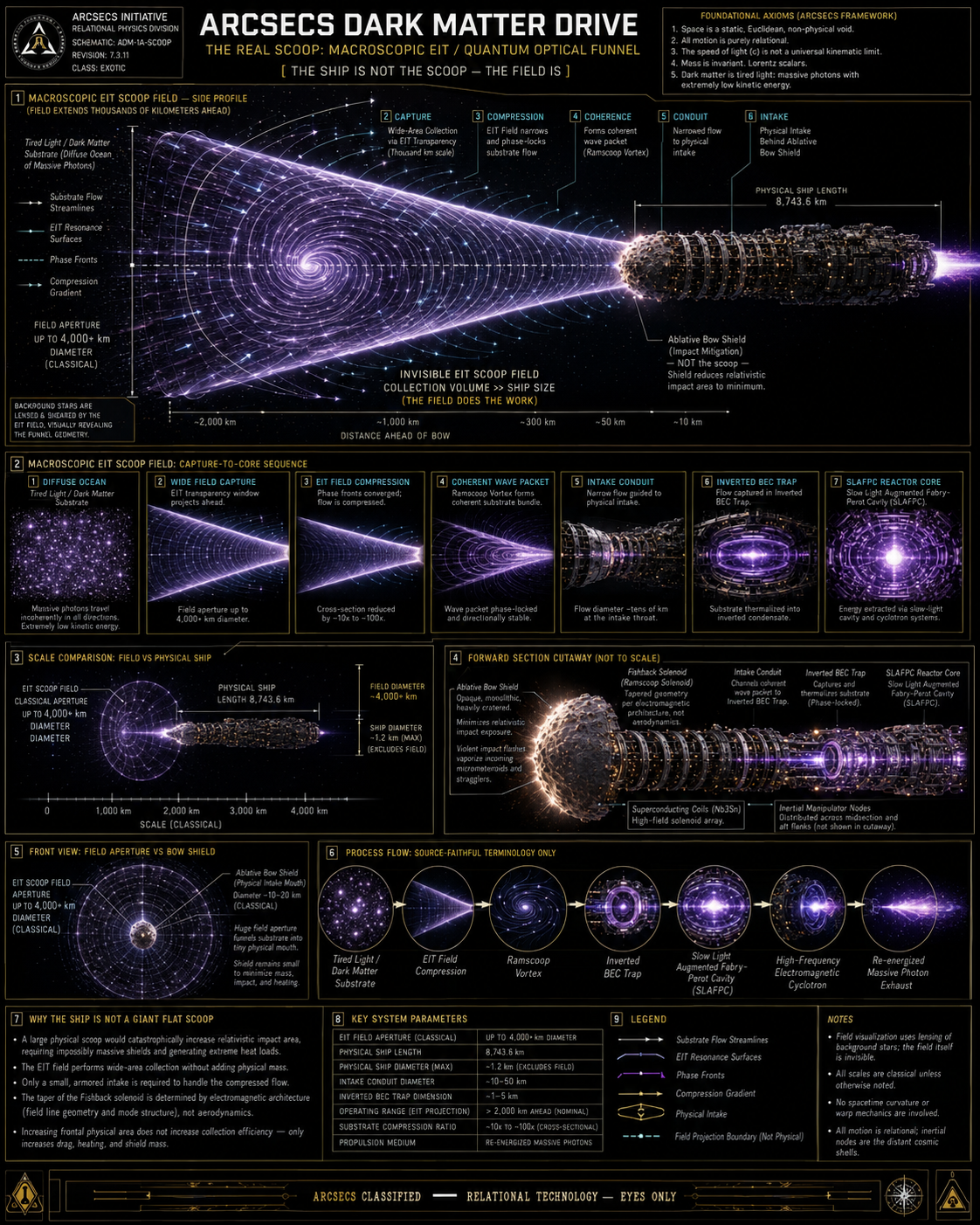
The ArcSecs Dark Matter Drive: A Thought Experiment in Relational Faster-Than-Light Propulsion
What would interstellar propulsion look like if the speed of light were not the final wall, dark matter were not exotic missing particles, and inertia itself were something a spacecraft could negotiate with the universe?
That is the premise behind the ArcSecs Dark Matter Drive: not a conventional rocket, not a warp bubble, and not a shortcut through folded spacetime, but a speculative propulsion architecture built from an alternate set of physical assumptions.
Editorial note: This article is presented as a speculative physics thought experiment, not as accepted mainstream cosmology or a near-term engineering proposal. Its purpose is to explore how a radically different model of light, dark matter, inertia, and motion could be translated into a coherent spacecraft architecture.
1. FTL as an Architecture Problem
In standard relativity, faster-than-light travel is not merely difficult. It is structurally forbidden. A massive object cannot be accelerated to the speed of light because the energy required rises without bound as velocity approaches c. In the standard model, c is not just the speed of light; it is the causal speed limit of the universe.
The ArcSecs Dark Matter Drive begins by changing the premise.
Instead of treating spacetime as a physical fabric, this framework treats space as a static, Euclidean, non-material void. Motion is not motion “through spacetime.” Motion is the changing relationship between bodies.
Instead of treating c as a universal kinematic ceiling for all motion, this framework treats it as the local phase velocity of electromagnetic propagation. In that picture, the speed of light is a property of the electromagnetic substrate, not necessarily a hard prohibition against all possible relational separation rates.
Instead of treating dark matter as an unknown particle population, the framework identifies it with a slow-light residue: ancient photons that have lost kinetic energy across cosmic time, become sub-luminal, and accumulated into gravitationally active but optically dark structures.
And instead of treating inertia as an intrinsic, unchangeable property of matter, the framework treats inertia as emergent from the gravitational relationship between a local body and the distant mass of the cosmos.
Those four assumptions create the design space for the ArcSecs Dark Matter Drive. They also make the vehicle radically different from most fictional FTL concepts. There is no wormhole throat. No Alcubierre-style bubble. No “hyperspace” layer. No mysterious drive crystal.
There is only a spacecraft, a dark cosmic fuel substrate, and a relational strategy for reducing the effective resistance to acceleration.
2. The Fuel: Dark Matter as Exhausted Ancient Light
The central fuel source of the drive is not antimatter, fusion plasma, or onboard nuclear propellant. It is dark matter, interpreted through the ArcSecs slow-light model as tired light.
In this framework, light does not remain forever at the same energy state during cosmological travel. Over extreme distances and durations, photons progressively lose kinetic energy. Their frequencies drop. Their wavelengths lengthen. Eventually, in the most speculative extension of the idea, some portion of this radiation falls out of the ordinary visible and high-frequency electromagnetic regime entirely.
The result is a population of sluggish, massive, gravitationally active quanta: light that no longer behaves like ordinary light.
These “slow quanta” would not shine in telescopes. They would not scatter like ordinary visible photons. They would not announce themselves through familiar electromagnetic brightness. But if they retain invariant mass, they would still gravitate.
That makes them a candidate fuel substrate for the thought experiment: a dark, cold, ancient ocean of optically exhausted light distributed throughout galactic halos, cosmic filaments, and intergalactic voids.
A normal rocket must bring propellant along for the trip. The Dark Matter Drive treats the cosmos itself as the propellant tank.
3. From Bussard Ramjet to Dark Matter Ramscoop
The closest classical ancestor of the ArcSecs Dark Matter Drive is the Bussard ramjet.
A Bussard ramjet is a proposed interstellar spacecraft that uses a vast magnetic field to scoop up hydrogen from the interstellar medium. That hydrogen would then be compressed and used as fusion fuel. In theory, this avoids the impossible mass penalty of carrying all propellant onboard.
The problem is that interstellar hydrogen is extremely sparse. To collect enough of it, the magnetic scoop must be enormous. Worse, the act of scooping can generate drag. In many analyses, the drag exceeds the thrust, turning the ramjet into a brake.
The ArcSecs version changes the medium.
Instead of scooping rare hydrogen atoms, it scoops the slow-light dark matter substrate. In the thought experiment, this substrate is more ubiquitous and more directly useful because it already consists of massive electromagnetic quanta.
The drive therefore becomes a dark matter ramscoop: a propulsion system designed to ingest sub-luminal massive photons, compress them into a reactor core, re-energize them, and expel them as directed exhaust.
The intake is not merely a mechanical opening. It is a field architecture. At the front of the vessel, an enormous intake projects an optical and electromagnetic capture region far beyond the physical hull. This region functions less like a scoop in water and more like a relational funnel in a hidden medium.
4. The Physical Shape of the Vessel
The ArcSecs Dark Matter Drive would not look sleek in the aerodynamic sense. It does not need to move through air. Its shape is dictated by radiation, impact protection, field projection, heat management, and quantum stability.
From front to rear, the vessel can be imagined as five major architectural zones.
4.1 The Ablative Bow Shield
At relativistic and superluminal velocities, even sparse interstellar matter becomes dangerous. Hydrogen atoms, dust grains, and microscopic debris become high-energy impactors.
The forward face of the vessel therefore begins with a massive ablative shield. It is not decorative. It is a sacrificial battering ram.
This shield might be built from layered ice, structured water, graphene composites, carbon nanotube reinforcement, or other speculative high-strength metamaterials. Its purpose is to absorb, vaporize, deflect, or radiatively dissipate the energy of matter encountered along the flight path.
Visually, the bow would be terrifying. At operating velocity, it would glow with continuous impact radiation. Microscopic collisions would flash across the forward shield like a permanent storm of bremsstrahlung, X-rays, gamma bursts, and visible plasma sparks. The ship would appear to carry a miniature thermonuclear sunrise at its nose.
4.2 The Fishback Solenoid Intake
Behind the bow shield sits the intake architecture: a long, tapering, heavily braced solenoid structure inspired by advanced ramjet concepts.
This structure can be imagined as a narrow forward paraboloid widening toward the reactor core. It is wrapped in superconducting coils, reinforced against extreme tensile stresses, and designed to shape the enormous capture field ahead of the vehicle.
The physical coils are only the visible skeleton. The true intake is the projected field extending thousands of kilometers outward.
To an external observer, the field itself would not be directly visible. But its effect on light would be. Stars behind the intake region would smear, bend, and spiral. The background sky would appear to twist into a vortex as the dark substrate is drawn inward.
The ship does not simply fly through the night. It drags the night toward itself.
4.3 The EIT Compression Funnel
The intake field uses a speculative macroscopic version of Electromagnetically Induced Transparency, or EIT.
In laboratory physics, EIT can alter the optical properties of a medium and dramatically slow the group velocity of light. In the ArcSecs thought experiment, a vast engineered EIT field is projected in front of the vessel to manipulate the incoming slow-light substrate.
The purpose is not merely to collect dark matter. It is to make the tired-light quanta coherent enough to compress.
The EIT funnel forces the ambient massive photons into a denser, more ordered wave packet. This reduces dispersion, aligns the incoming substrate with the spacecraft’s intake geometry, and prepares it for trapping inside the reactor system.
4.4 The BEC Trap and Slow-Light Fabry-Perot Core
Once the dark substrate enters the intake, it is routed into a quantum containment system: an inverted Bose-Einstein-condensate-style trap and a Slow Light Augmented Fabry-Perot Cavity.
The cavity is lined with ultra-reflective boundaries. The massive photons bounce back and forth millions of times. Each reflection compounds the phase relationship inside the cavity, increasing sensitivity and compression. The goal is to strip away residual dispersion and pack the tired light into a dense, localized reactor state.
This is where the drive stops being a scoop and becomes a converter. The dark, cold, ancient light is now concentrated. The reactor is ready to resurrect it.
4.5 The Aft Photon-Expulsion Aperture
At the rear of the ship, there is no ordinary rocket bell.
Instead, the drive uses a reinforced photon-expulsion aperture: a metamaterial-lined exhaust channel designed to release re-energized massive photons in a tightly collimated beam.
If the reactor is the heart of the drive, this aperture is the voice.
The exhaust would appear as a blinding spear of electromagnetic energy. Depending on conversion efficiency and emission spectrum, it could resemble an artificial gamma-ray burst: narrow, lethal, brilliant, and almost impossibly energetic.
The ship does not leave smoke. It leaves a wound of awakened light.
5. The Thrust Cycle: How the Drive Converts Darkness Into Motion
The Dark Matter Drive’s propulsion cycle can be summarized in six stages.
| Stage | Process | Purpose |
|---|---|---|
| 1 | Dark substrate encounter | The ship moves through tired-light dark matter. |
| 2 | EIT field projection | The intake field slows, aligns, and coheres the substrate. |
| 3 | Ramscoop compression | Massive photons are funneled into the vessel. |
| 4 | Quantum cavity trapping | The slow quanta are packed into a dense reactor state. |
| 5 | Cyclotron re-energization | The reactor restores kinetic energy to the massive photons. |
| 6 | Aft expulsion | Re-energized massive photons are expelled as thrust. |
The key difference between this drive and a conventional photon rocket is the assumed mass of the exhaust.
A classical photon rocket expels massless photons. Its thrust is limited by the momentum carried by radiation, making it extraordinarily power-hungry.
The ArcSecs drive assumes the exhaust consists of massive photons under a Proca-like electrodynamic framework. That means the expelled radiation is not merely light pressure. It is massive exhaust moving at the local electromagnetic phase limit.
In simplified terms, the drive is trying to turn dark matter into reaction mass. That is the central trick.
The universe supplies the propellant. The ship supplies the re-energization. The exhaust supplies the push.
| Propulsion System | Fuel Source | Exhaust Mechanism | Thought-Experiment Assessment |
|---|---|---|---|
| Traditional Bussard Ramjet | Sparse interstellar hydrogen | Thermonuclear fusion | Potentially limited by extreme scoop scale and drag. |
| Nuclear Photonic Rocket | Onboard fissionable or fusion energy source | Massless photon emission | Power-intensive because thrust comes from radiation pressure. |
| Direct-Drive Fusion | Fusion fuel such as deuterium/helium-3 | Charged particle exhaust | More efficient than photon thrust, but still bound by conventional exhaust limits. |
| ArcSecs Dark Matter Drive | Ubiquitous tired-light dark matter | Re-energized massive photons | Speculatively converts dark substrate into massive electromagnetic exhaust. |
6. Relational Inertia: The Hidden Lever
Even a powerful engine is not enough unless the spacecraft can overcome inertia.
In standard physics, inertia is treated as a property of the object. A ship has mass. That mass resists acceleration. The faster the ship goes, the harder continued acceleration becomes under relativistic dynamics.
The ArcSecs framework shifts the question.
What if inertia is not purely internal? What if inertia is the local expression of a body’s relationship with all other mass in the universe?
This is where the thought experiment invokes Mach-like relational mechanics. The ship’s resistance to acceleration is treated as an emergent consequence of its gravitational relationship with distant cosmic shells.
If inertia is relational, then it may vary with environment, direction, and large-scale mass distribution. That opens the possibility of inertial mass manipulation.
The spacecraft does not need to “break” inertia. It needs to change its relationship to the cosmic mass distribution that generates inertia.
In the thought experiment, the Dark Matter Drive carries inertial manipulation nodes distributed around its hull. These nodes generate localized field gradients that alter how the vessel couples to the surrounding cosmic mass shell.
When active, these systems would produce strange optical effects. The hull would blur. Edges would refuse to resolve. The ship would appear to shimmer or phase, not because it enters another dimension, but because its local relation to light, mass, and inertia is being distorted.
To look directly at the ship during full inertial decoupling would be disorienting. It would not look like a vehicle moving quickly. It would look like a vehicle becoming less obligated to obey the same resistance as everything else.
7. The Problem of Ramscoop Drag
A classical Bussard ramjet faces a brutal problem: the scoop that collects fuel can create more drag than the engine creates thrust.
The Dark Matter Drive avoids this with a speculative mechanism called Weber induction slipstreaming.
In the relational framework, gravitational and inertial interactions depend not only on distance, but also on relative radial velocity and acceleration. By pulsing the EIT field and rotating or modulating the intake structure at carefully selected resonant frequencies, the drive attempts to align its acceleration relationship with the incoming dark substrate.
The goal is to cancel the relational drag profile of the scooped mass.
Instead of pushing into the dark matter ocean like a net through water, the vessel creates a slipstream in the inertia field. The substrate is swallowed without imposing fatal deceleration.
This is one of the most speculative parts of the architecture, but it is also one of the most important. Without drag cancellation, the entire drive becomes a cosmic brake. With it, the intake becomes a fuel source rather than a liability.
8. Crossing the Cosmic Bubble: The Three-Phase Flight Profile
The ArcSecs Dark Matter Drive is not just an engine. It is a navigation concept.
The thought experiment imagines a spacecraft traveling across a static cosmic bubble: departing from one side, passing through the center, and emerging toward the opposite side.
That journey divides into three relational regimes.
Phase 1: Departure and the Decay of Local Inertia
At departure, the ship is still strongly coupled to the local mass concentration: its galaxy, cluster, and supercluster.
As the drive accelerates away, that local gravitational influence weakens with distance. In the relational model, this means the ship’s inertia begins to decay. Its resistance to acceleration decreases as it becomes less dominated by the mass region it left behind.
The same engine output now produces greater acceleration. The ship enters an inertial freefall condition.
At this stage, the massive-photon exhaust is doing more than pushing the ship forward. It is pushing a ship whose effective inertial burden is falling away.
This is where the drive first crosses the light barrier in the thought experiment. Not by overpowering relativity, but by changing the relational conditions under which acceleration is calculated.
Phase 2: The Zero-Point Equilibrium at the Cosmic Center
As the ship approaches the center of the cosmic bubble, the gravitational pull of the surrounding universe becomes more isotropic.
Mass lies in every direction. The origin-side pull and destination-side pull balance.
In ordinary Newtonian terms, this might suggest a region of near-zero net gravitational force. In the ArcSecs relational interpretation, it is more profound: a zone of balanced inertial relation.
At the center, the ship experiences its minimum stable inertial resistance. It is not being strongly claimed by one side of the cosmic mass distribution or the other.
This region is also imagined as a dense reservoir of slow-light dark matter. If tired light pools gravitationally over cosmic time, then the center of the static bubble becomes an extreme fuel-rich zone.
The ramscoop saturates. The reactor runs at peak capacity. The ship crosses the cosmic midpoint with maximum fuel intake and minimal inertial opposition.
Phase 3: Distal Pull and Gravitational Induction
After crossing the center, the relational geometry reverses.
The destination side of the universe becomes the dominant mass vector. The ship is now falling toward the far side of the cosmic bubble.
The drive no longer needs to rely entirely on brute thrust. It can ride the relational pull of the distant mass distribution, using gravitational induction like a cosmic towline.
At this stage, the ramscoop shifts roles. It remains a fuel intake, but it also becomes a stabilizing system. The drive modulates exhaust to maintain superluminal velocity while controlling relative acceleration.
That control matters. Without it, the ship could arrive at the destination side with catastrophic kinetic excess. The final challenge is not acceleration. It is braking.
9. What the Crew Would See Before FTL
Before the ship crosses the light barrier, the visual universe already becomes strange.
As velocity rises, stellar aberration pulls the apparent positions of stars forward. Stars that were once off to the side slide toward the direction of travel. The celestial sphere collapses into a forward cone.
At moderate relativistic speed, the crew sees the sky crowd ahead. At extreme relativistic speed, nearly the entire visible universe compresses into a brilliant starburst directly in front of the ship.
Behind the ship, the sky darkens. The universe appears to fold forward.
Then the colors begin to fail.
Because of Doppler shifting, forward starlight is blueshifted to higher frequencies. Infrared becomes visible. Visible light becomes ultraviolet. Ultraviolet becomes X-ray and gamma radiation.
For a brief period, the crew may see an impossible bloom of hyper-saturated color as invisible infrared is pushed into the visible range. Then the forward view vanishes from human sight.
The stars are still there, but their light has shifted beyond the eye. The forward window becomes dark not because there is no radiation, but because the radiation has become too energetic to see.
The ship is flying into an invisible storm.
| Relational Velocity | Geometric Aberration | Forward Spectral Shift | Aft Spectral Shift |
|---|---|---|---|
| Rest | Stars are evenly distributed across the celestial sphere. | Baseline visible spectrum. | Baseline visible spectrum. |
| Low relativistic | Stars skew forward; peripheral sky thins. | Mild blueshift; infrared can move into visible red. | Mild redshift; visible light shifts toward longer wavelengths. |
| High relativistic | Most starlight collapses into the forward field of view. | Extreme blueshift; visible light can move into ultraviolet or beyond. | Extreme redshift; visible light can move into infrared. |
10. What Happens After the Light Barrier
Once the ship exceeds the local propagation speed of light, the optical environment becomes paradoxical.
The aft view goes black. Light from behind can no longer catch the ship. Even the ship’s own exhaust light cannot overtake it.
Forward sensors encounter light in a reversed informational order. Since the ship is moving faster than the photons emitted by distant objects, it can intersect later light before earlier light.
A supernova might appear backward. A stellar explosion could be seen first as an expanding remnant, then as the explosion itself, then as the original star.
Causality is not necessarily being reversed in the physical event. The ship is simply crossing the light record in reverse order. To the crew, however, the universe would look broken.
Events would peel backward. Systems would flicker through asynchronous histories. The cosmos would stop behaving like a live image and start behaving like an archive being read from the wrong end.
11. The Ghost Ship Effect
To an external observer, the ArcSecs Dark Matter Drive would be even stranger.
If the ship travels faster than its own emitted light, an observer at the destination would not see it approach. The physical vessel would arrive first. Only later would the light from its journey reach the observer.
This creates the “ghost ship” effect.
The ship appears suddenly, silently, impossibly. Then, after arrival, a phantom image of the ship seems to travel backward along its route, as delayed light from the approach path finally catches up.
The observer sees the evidence after the event. The arrival precedes the image. The ship becomes a physical object followed by its own optical memory.
12. Vacuum Cherenkov Wake in a Slow-Light Medium
In ordinary physics, Cherenkov radiation appears when a charged particle moves through a medium faster than light can propagate in that medium. The familiar blue glow in nuclear reactor water is an example.
A true vacuum does not produce ordinary Cherenkov radiation because no massive particle exceeds c in standard relativity.
But the ArcSecs framework does not treat the void as empty. It treats it as filled with tired-light dark matter: a cosmic medium of massive, slow electromagnetic quanta.
If the ship moves faster than electromagnetic waves propagate through that substrate, it generates a vacuum-like Cherenkov analogue.
But this would not be a soft blue glow. It would be a violent bow shock.
The hull, intake field, and massive-photon exhaust would carve through the dark substrate, producing a high-energy wake of X-rays, gamma radiation, and re-excited optical debris.
The path of the ship would remain visible long after transit as a luminous scar through the dark sector. In this sense, the Dark Matter Drive is not stealthy. It is a cosmic disruption event.
| Superluminal Phenomenon | Trigger | Visual Effect |
|---|---|---|
| Aft light horizon | Vessel outruns rearward photons. | The aft view becomes permanently black. |
| Reverse light-record reading | Vessel intersects photons in reverse chronological order. | Distant events can appear to unfold backward. |
| Ghost ship arrival | Physical arrival precedes the light from the approach. | The ship appears suddenly, followed by its delayed optical history. |
| Vacuum Cherenkov analogue | Superluminal interaction with slow-light dark matter. | A high-energy X-ray/gamma bow shock and luminous wake. |
13. The ArcSecs Technology Stack Inside the Thought Experiment
A drive this unstable requires extraordinary precision. The reactor depends on coherent quantum states. The intake depends on field alignment. The ship’s inertial manipulation depends on real-time relational calculations across enormous mass distributions.
Small errors are not small. A misaligned intake could lose coherence. A vibration in the wrong frequency band could collapse the slow-light trap. A thrust imbalance could create inertial shear across the hull.
That is where the ArcSecs technological layer enters the story.
| System | Role in the Drive | Why It Matters |
|---|---|---|
| SAGITTA-class star tracking | Primary navigation | Tracks distorted, blueshifted stellar profiles during extreme velocity. |
| TWINKLE-class distributed trackers | Redundant hull sensing | Provides multiple attitude references across the spacecraft body. |
| SCORPIO-class radiation-hardened sensors | Deep-space resilience | Maintains tracking during high-energy Proca-field radiation exposure. |
| ZYRA reaction wheels | Quiet attitude control | Prevents microvibrations from decohering the BEC-style slow-light trap. |
| ArcSecs AI/navigation stack | Relational computation | Integrates dark-sector telemetry, starfield distortion, and Weber-force inertia vectors. |
The most important engineering requirement is not raw power. It is stability.
The drive is balancing three violent systems at once: a quantum intake, a high-energy massive-photon reactor, and a changing inertial relationship with the rest of the universe.
The spacecraft must know where it is, how it is oriented, what the dark substrate is doing, how the exhaust is coupling, and whether its own effective inertia is shifting faster than the hull can tolerate.
A normal flight computer is not enough. The ship needs a relational autopilot.
14. Why This Thought Experiment Matters
The ArcSecs Dark Matter Drive is not valuable because it gives us a buildable starship blueprint. It is valuable because it forces several hidden assumptions into the open.
When we say faster-than-light travel is impossible, which layer of the model is doing the forbidding?
- Is it the observed behavior of light?
- The mathematical structure of spacetime?
- The interpretation of inertia?
- The assumption that dark matter is particle matter rather than altered radiation?
- The assumption that redshift means expansion rather than energy loss?
- The assumption that a photon cannot have any rest mass whatsoever?
The ArcSecs approach does not ask readers to accept every alternate premise as fact. It asks them to inspect the load-bearing assumptions beneath the standard picture.
That is the real function of the Dark Matter Drive. It is a probe — not a probe of Alpha Centauri or the cosmic horizon, but a probe of our conceptual architecture.
It asks: What would engineering look like if the hidden universe were made of slowed light?
It asks: What would propulsion look like if inertia were relational?
It asks: What would cosmology look like if redshift, darkness, and gravity were more connected than our current categories allow?
And most importantly: What would we need to measure to know?
15. Conclusion: A Machine Built From Questions
The ArcSecs Dark Matter Drive is a speculative machine assembled from four radical ideas:
- Space is not a fabric.
- Light may have hidden massive states.
- Dark matter may be exhausted radiation.
- Inertia may emerge from cosmic relationships.
Within that alternate architecture, faster-than-light travel becomes not a magic trick, but an engineering sequence: harvest slow light, compress it, re-energize it, expel it, and reduce the ship’s inertial coupling to the cosmic mass shell.
The resulting spacecraft is brutal, luminous, dangerous, and beautiful.
Its bow burns with impact radiation. Its intake twists the starfield into a vortex. Its reactor resurrects ancient light. Its exhaust becomes an artificial gamma-ray spear. Its hull blurs as it negotiates inertia. Its passage leaves a Cherenkov scar through the dark sector. And its arrival precedes its own image.
Whether such a machine can exist is not the first question.
The first question is whether the universe contains the hidden relationships such a machine would require.
That is where ArcSecs begins:
Observe. Measure. Question the cosmic ruler.
References and Links
The following links are collected from the source materials used to build this WordPress version. Some are mainstream references, some are speculative or non-mainstream sources, and some are community discussions. Review before publication and remove any sources you do not want cited publicly.
- No Universal Speed Limit Theory.pdf. Source document cited in the uploaded materials.
- DarkMatterDriveFTLThoughtExperiment.html. Source document cited in the uploaded materials.
- viXra.org e-Print archive: Astrophysics
- Bussard ramjet — chemeurope.com
- Why do Federation starships need Bussard collectors?
- A Theory of the Universe and Matter — Academia.edu
- The Equation of the Universe — SCIRP
- Type Ia Supernovae Hubble Diagram Reveals a Static Universe — SCIREA
- Gravitational induction with Weber’s force — Canadian Science Publishing
- Relational Mechanics: Mach’s Principle and Weber’s Force — Unicamp
- Inertial Mass in a Machian Framework — viXra
- Weber’s Electrodynamics — Assis slides
- How do we know the expansion of space exists? — Reddit AskScience
- A Fundamentally Irreversible World — SCIRP
- ENTECH March 2024 Volume 2 Issue 3 — Zenodo
- Shell Universe — MDPI
- Mach’s Principle: Anti-Epiphenomenal Physics — LessWrong
- Mach’s principle — Wikipedia
- Relational Mechanics — ResearchGate
- Simple Sensible Cosmology — Space and Motion
- Gravitational induction with Weber’s force — ResearchGate
- Gravitational Induction with Weber’s Force — ResearchGate PDF
- Changing the Inertial Mass of a Charged Particle — JPS Journals
- Particles with Negative Mass — Qucosa / TU Dresden
- The Interstellar Ramjet at 60 — Centauri Dreams
- Nuclear photonic rocket — Wikipedia
- Photon rocket — Wikipedia
- Non-null gravitational force exerted by a spherical shell — ResearchGate
- Gravitational Induction with Weber’s Force — Unicamp repository
- Gravitational Induction with Weber’s Force — Unicamp PDF
- Nuclear Photon Rockets: Flashlights to the Stars — ToughSF
- Nuclear Photon Rockets discussion — Kerbal Space Program Forums
- Photon drives discussion — Reddit Terra Invicta
- Weber’s Electrodynamics — Unicamp PDF
- Relational Mechanics — Unicamp PDF
- Mach’s Principle Revised — SCIRP
- On Mach’s critique of Newton and Copernicus — arXiv
- Mach’s Principle and the Origin of Inertia
- The Reality of Newtonian Forces of Inertia — Unicamp
- Relational Mechanics — Unicamp 2017 PDF
- Weber’s Electrodynamics — hlevkin PDF
- Interstellar travel — Wikipedia
- arXiv:1512.06326 — Massive photon / related formalism
- de Broglie-Proca and Bopp-Podolsky massive photon gases in cosmology — UNESP
- Federico II thesis source — fedOA
- Crafting the Bussard Ramjet — Centauri Dreams
- Nearlight Starships — Atomic Rockets
- The Bussard Ramjet — Stanford
- Interstellar Bussard ramjet magnetic field discussion — Reddit Space
- FTL neutrino bremsstrahlung discussion — MIT
- Bussard ramjet — Wikipedia
- Questions about the Bussard ramjet — Reddit AskScienceDiscussion
- A Laser-Powered Interstellar Ramjet — Centauri Dreams
- Electromagnetic Math — NASA Science
- Eclipse Phase: Gatecrashing PDF
- What would a relativistic interstellar traveller see? — UCR
- The Celestial View From a Relativistic Starship — The Oikofuge
- Relativistic ray tracing proposal — Stanford Graphics
- Relativistic Doppler effect — Wikipedia
- Doppler effect — Wikipedia
- Doppler shift — NASA Imagine the Universe
- Visual speed discussion — Reddit AskPhysics
- Doppler Shift — UCLA Astronomy
- Gravity Probe B teacher guide — Stanford
- Imagine I can travel faster than light. Will I still be able to see light? — Quora
- How would an object larger than a light year be visually distorted? — Reddit Physics
- Faster Than Light — Semantic Scholar
- Superluminal motion — Wikipedia
- Cherenkov radiation — Wikipedia
- Would traveling faster than light in a vacuum produce Cherenkov radiation? — Reddit AskPhysics
- Cherenkov radiation and superluminal particles — arXiv
- Vacuum Cherenkov Radiation — Physics Stack Exchange